DOW-UAP-D130

AAWSAP DIRD, Technological Approaches to Controlling External Devices, March 2010, page 14

One page of a U.S. government record released under PURSUE, shown on its own with its text. The record page has the whole document, its catalog details and the scan.

Page
14 of 36
Agency
Department of War
Released
Release 06, September 18, 2026

Text of page 14

UNCLASSIFIED//FOR eFF AL USE ONLY Commercial EEG sensors MindSet, by NeuroSky nia, by OCZ Technology Figure 3. Two Commercially Available EEG Sensors. The MindSet utilizes two sensors, one in the right earphone and one for placement on the forehead (what looks like a microphone arm is to be pressed against the forehead). The nia records signals from three sensors on the forehead. In a documented and peer-reviewed study, Popescu and colleagues have shown a system that uses 6 dry electrodes and is 90 percent accurate in operation of a 1-D cursor by untrained subjects. Additionally, a measurement of error rates as a function of number of electrodes show that an increase to 12 electrodes could drop the error rate to around 5 percent, but that additional electrodes much beyond a dozen do not significantly improve the accuracy of their algorithm (Reference 28). MEG MEG-based BMI systems have been shown to be feasible utilizing a subject imagining limb movements for binary decisions (References 29, 30). Future work could improve the methodology to parallel that achieved with EEG; however, there are significant technological hurdles to a field deployment of MEG. The magnetic fields from neural activity are detected with very sensitive devices called superconducting quantum interference devices, or SQUIDs. These detectors are sensitive to the neural activity induced 100 fT (femtoTesla) changes near the scalp. SQUIDs only operate at very low temperatures thus requiring a cryogenic system as well significant detection and amplification electronics. The availability of a cold sink and high vacuum, such as in a space-based application, could reduce the support system overhead, but there is still the matter of the weakness of the signals. Even if future detector development like atomic magnetometers would solve the equipment overhead issue for Earthbound application, the fact that 100 fT is about 100 million times smaller than the Earth's magnetic field will prove an insurmountable barrier to sifting signal from noise in anything but a heavily-shielded, metal-free environment. Attempts have been made to use High-Tc superconductors as a shielding material with some success (Reference 31), but significant further development is needed. 8 UNCLASSIFIED//FOR AL USE ONLY

Machine-read (OCR) from the scan by this archive; it can contain errors. The scan is the record.
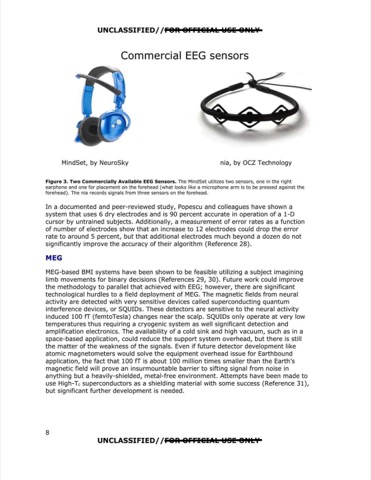
Image from page 14 of DOW-UAP-D130, as released by war.gov
Image from page 14 of the PDF. Open the scan to see the whole page.

Cite this page

U.S. Department of War. "AAWSAP DIRD, Technological Approaches to Controlling External Devices, March 2010" (DOW-UAP-D130). PURSUE Release 06, U.S. Department of War, September 18, 2026. https://www.war.gov/medialink/ufo/sept-18/release-06/assets/DOW-UAP-D130_AAWSAP-DIRD-Technological-Approaches-to-Controlling-External-Devices-March-23-2010.pdf. Declassified UAP, page 14, https://declassifieduap.org/r/dow-uap-d130-aawsap-dird-technological-approaches-to-controlling-external-devices-march-2010/p/14. Accessed November 28, 2026.

This address shows page 14 on its own; /r/dow-uap-d130-aawsap-dird-technological-approaches-to-controlling-external-devices-march-2010?page=14 opens the same page in the full reader. Both stay. How to cite.