DOW-UAP-D130

AAWSAP DIRD, Technological Approaches to Controlling External Devices, March 2010, page 11

One page of a U.S. government record released under PURSUE, shown on its own with its text. The record page has the whole document, its catalog details and the scan.

Page
11 of 36
Agency
Department of War
Released
Release 06, September 18, 2026

Text of page 11

UNCLASSIFIED/ FOR eFFrEIAL USE ONLY of a spiking train to trigger a switch, or as complex as decoding signal from noise utilizing a 300-channel EEG cap. Additional sensory Input interface Components of a Closed-loop BMI Control System Input signal processing Brain Output interface Output signal processing External Device Figure 2. The General Layout of a Closed-Loop Control Interface. The input and output interfaces can attach to read or affect activity of cerebral or peripheral neurons. Additional sensory feedback channels such as visual displays, audio tones, or haptic feedback are possible. In some system designs, especially noninvasive types, these sensory feedback channels replace stimulation inputs. In an open-loop interface, either the input or output signal paths are absent. One consideration in developing a BMI control system is the utility of the application: does it make sense to directly tie these controls to neural activity? The bulk of research in direct neural interfaces is toward the goal of restoring mechanical capabilities to those individuals who have either lost limbs or lost control of limbs through central nervous system injury or disease. In these cases it is of obvious utility to produce a system that moves a cursor across screen to select an item over the course of several seconds; however, for a healthy individual, it is far more practical to execute a hand novement to control a mechanical device to achieve the same goal. An exception to consider is the case of applications where the subject's hands or feet are already occupied with other essential tasks in the overall application. A research question for any such application is whether training a subject to utilize a BMI is advantageous over a more complex mechanical interface. Furthermore, whether training on a new BMI affects learning/retaining proficiency with similar BMIs is an additional concern. Moreover, for any BMI, one can quantitatively describe the information transfer in controlling the magnitude of human motor action (Reference 12). Since the advent of digital control of external devices, this information is expressed in equivalent bits per 4 Mechanical device as used here represents any limb-operated interface, such as a mouse or touchscreen. 5 UNCLASSIFIED//FOR OFFICIAL USE ONLY

Machine-read (OCR) from the scan by this archive; it can contain errors. The scan is the record.
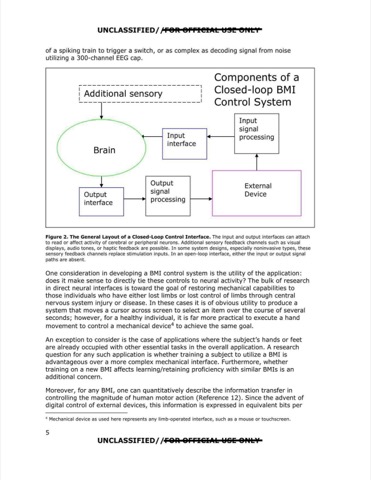
Image from page 11 of DOW-UAP-D130, as released by war.gov
Image from page 11 of the PDF. Open the scan to see the whole page.

Cite this page

U.S. Department of War. "AAWSAP DIRD, Technological Approaches to Controlling External Devices, March 2010" (DOW-UAP-D130). PURSUE Release 06, U.S. Department of War, September 18, 2026. https://www.war.gov/medialink/ufo/sept-18/release-06/assets/DOW-UAP-D130_AAWSAP-DIRD-Technological-Approaches-to-Controlling-External-Devices-March-23-2010.pdf. Declassified UAP, page 11, https://declassifieduap.org/r/dow-uap-d130-aawsap-dird-technological-approaches-to-controlling-external-devices-march-2010/p/11. Accessed November 28, 2026.

This address shows page 11 on its own; /r/dow-uap-d130-aawsap-dird-technological-approaches-to-controlling-external-devices-march-2010?page=11 opens the same page in the full reader. Both stay. How to cite.