Text of page 6
UNCLASSIFIED//FOR OFFTErAL USE ONLY
2. Giant Magnetoresistance
2.1 GMR BASICS
This section discusses the phenomenon of giant magnetoresistance (GMR). Excellent
reviews of GMR are available elsewhere (Reference 12-22). The focus on physical
concepts important for the sections to follow are discussed.
GMR in magnetic multilayers refers to a dramatic reduction in the resistance of the
multilayers when subjected to an external magnetic field. GMR's size is usually defined
as the resistance change in magnetic field relative to its peak value. The effect can be
distinguished from the ordinary magnetoresistance (MR) coming from the direct action
of the magnetic field on the electron trajectories via the Lorentz force (Reference 23),
and from the anisotropic MR, which comes from dependence of the resistivity on the
relative orientation of magnetic moment to the current (Reference 24).
To prepare the magnetic multilayers,
where several atomic layers of one
(ferromagnetic) material alternate by
layers of another (nonmagnetic)
material (see Figure 1), a wide variety
of deposition methods have been used,
Current
In
the Plane
such as electrochemical deposition
techniques (Reference 25, 26) and
various vacuum deposition techniques
(Reference 27, 28). The latter shares
mainly between two methods using
either sputter deposition or molecular
beam epitaxy (MBE) systems. Sputter
deposition involves knocking off the
atoms of the material of interest from a
target by particle bombardment,
Current
Perpendicular
to the Plane
followed by the deposition of high-
energetic atoms (~2-30 electronvolts
[eV]) onto the substrate. A principal
advantage of sputter deposition is the
ease with which many different
materials can be deposited at relatively
high deposition rates. In contrast,
deposition rates in MBE systems are
usually much lower than for sputtering
systems, but much lower energies
008600
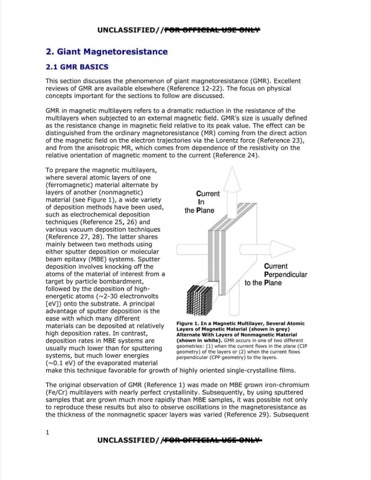
Figure 1. In a Magnetic Multilayer, Several Atomic
Layers of Magnetic Material (shown in grey)
Alternate With Layers of Nonmagnetic Material
(shown in white). GMR occurs in one of two different
geometries: (1) when the current flows in the plane (CIP
geometry) of the layers or (2) when the current flows
perpendicular (CPP geometry) to the layers.
(~0.1 eV) of the evaporated material
make this technique favorable for growth of highly oriented single-crystalline films.
The original observation of GMR (Reference 1) was made on MBE grown iron-chromium
(Fe/Cr) multilayers with nearly perfect crystallinity. Subsequently, by using sputtered
samples that are grown much more rapidly than MBE samples, it was possible not only
to reproduce these results but also to observe oscillations in the magnetoresistance as
the thickness of the nonmagnetic spacer layers was varied (Reference 29). Subsequent
1
UNCLASSIFIED//FOR
OFF
AL USE ONLY