Text of page 12
UNCLASSIFIED//FOR OFFTE
AL USE ONLY
3.2 STT EXPERIMENTS
Section 3.1 introduced the physics of STT in magnetic nanosystems. We have seen that
a high-density electrical current can result in torques on magnetic elements of the
system. These torques may be used to control and manipulate the system's magnetic
state. However, the resulting behavior of the system can differ significantly from case
to case, depending on particular conditions of observation. For instance, in modest
external magnetic fields, magnetization of a small element can be repeatedly reversed
between two stable configurations, while at higher fields, where the reversal is
energetically unfavorable, the moment can be set into precession at a very high
frequency. To understand details of what happens with a magnetic moment 5 in a
particular situation, one can use Newton's Second Law.
For $ this would be the Landau-Lifshitz-Gilbert equation, where the rate of change of S
is set equal to the net torque acting on 5:
Equation 1:
as
di
"eff
a §x
+11 x Px8)
Here the first term on the right is the
torque on a magnetic moment $ in an
effective magnetic field B eff, (including
applied, demagnetizing, anisotropy, and
other fields), with y the gyromagnetic
ratio; the second term is a
phenomenological damping term
introduced by Gilbert, with a the Gilbert
damping parameter; the third term is
the SST where small s
and 5* are unit
vectors along $
and the polarizer 5*, I
is the current, us is the Bohr magneton,
e is the electron charge, and n is the
spin-polarization factor.
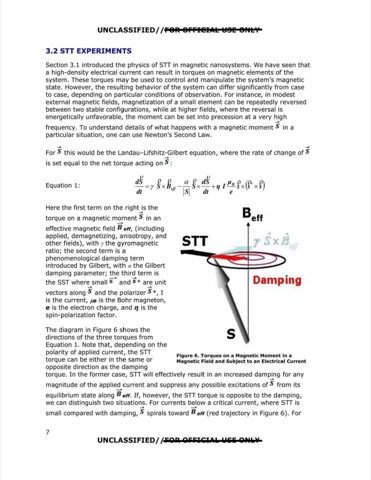
Beff
STT
Damping
The diagram in Figure 6 shows the
directions of the three torques from
S
Equation 1. Note that, depending on the
polarity of applied current, the STT
torque can be either in the same or
Figure 6. Torques on a Magnetic Moment in a
Magnetic Field and Subject to an Electrical Current
opposite direction as the damping
torque. In the former case, STT will effectively result in an increased damping for any
magnitude of the applied current and suppress any possible excitations of 5 from its
equilibrium state along Beff. If, however, the STT torque is opposite to the damping,
we can distinguish two situations. For currents below a critical current, where STT is
small compared with damping, $ spirals toward B eff (red trajectory in Figure 6). For
7
UNCLASSIFIED//FOR OFFICIAL USE ONLY