DOW-UAP-D128

AAWSAP DIRD, Anomalous Acute and Subacute Field Effects on Human Biological Tissues, March 2010, page 16

One page of a U.S. government record released under PURSUE, shown on its own with its text. The record page has the whole document, its catalog details and the scan.

Page
16 of 38
Agency
Department of War
Released
Release 06, September 18, 2026

Text of page 16

UNCLASSIFIED/ FOR OFFIETAL USE ONLY the "hotspot" range which lies between 400 MHz and 2 GHz. The heating is highly nonuniform with typical ratios between spatial peaks and whole body average specific absorption rates of the order of 150:1 to 200:1.' {above and Figure One adapted from [1]} Figure One absorption rate Subrangance Resonance range Whole body Partial; body (head): Hot spot range Normalised 30 300 400 2000 f(MHz) Variation of normalised specific absorption rate with frequency and related absorption characteristics in living organisms: reproduced with the permission of WHO from: Electromagnetic fields (300 Hz to 300 Ghz) 1993:76. (Environmental Health Criteria 137. A. THE EFFECTS THAT BURN From the perspective of aerospace applications, the millimeter wave length of emitters has been of greatest interest for human effects, and there have been extensive reviews documenting effects at both low and high levels of incident energy [20,21]. For our purposes, the most basic biophysical information that pertains is clear: with dry clothing, 90-95 % of the energy is efficiently absorbed with or without an air gap acting as an impedance transformer. These millimeter waves (30-300 GHz) penetrate the skin to a depth of several millimeters. The ANSI (American National Standards Institute) safety guideline of 5 mW/cm2 for RF /NIEMR equates to a SAR of 65-357 W/kg. The depth of penetration involves the area of cutaneous receptors, and at and above these levels will be perceived first, as prickling sensation, then pain and finally erythema and even second degree burns if exposures last on the order of minutes: burning can occur in a non-linear dose-effect range above these SAR levels, as described elsewhere in this paper. The threshold of heat perception is near 0.7 mW/cm, with power densities of about 9.0 mW/cm? causing sensations of pain within one second of exposure. It is notable, that the non-liner effects apply; e.g. for 3 GHz {decimeter, not millimeter wave lengths}, the thresholds are on the order of 30 times less. Indeed, especially in the Former Soviet Union, there is substantial literature on these wavelengths at SARs below 10s of W/kg (as with Diathermy Machines in the US in the '50s) being exploited for a wide range of external and internal (gastrointestinal) therapies. Of interest here, in the context of incident RF that can produce heating injury, are a series of very early experiments done at Brooks Air Force Base and the Oak Ridge National Laboratories during the Cold War era intended to study potential weapons and 9 UNCLASSIFIED+/FOR OFFICIAL USE ONLY

Machine-read (OCR) from the scan by this archive; it can contain errors. The scan is the record.
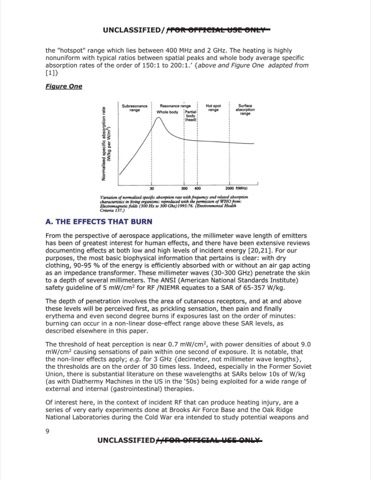
Image from page 16 of DOW-UAP-D128, as released by war.gov
Image from page 16 of the PDF. Open the scan to see the whole page.

Cite this page

U.S. Department of War. "AAWSAP DIRD, Anomalous Acute and Subacute Field Effects on Human Biological Tissues, March 2010" (DOW-UAP-D128). PURSUE Release 06, U.S. Department of War, September 18, 2026. https://www.war.gov/medialink/ufo/sept-18/release-06/assets/DOW-UAP-D128_AAWSAP-DIRD-Anomalous-Acute-and-Subacute-Field-Effects-on-Human-Biological-Tissues-March-11-2010.pdf. Declassified UAP, page 16, https://declassifieduap.org/r/dow-uap-d128-aawsap-dird-anomalous-acute-and-subacute-field-effects-on-human-biological-tissues-march-2010/p/16. Accessed November 28, 2026.

This address shows page 16 on its own; /r/dow-uap-d128-aawsap-dird-anomalous-acute-and-subacute-field-effects-on-human-biological-tissues-march-2010?page=16 opens the same page in the full reader. Both stay. How to cite.