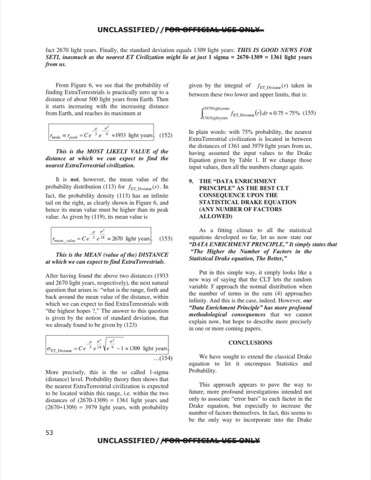
Text of page 53
UNCLASSIFIED/ /FeR OFFICIAL USE ONLY
fact 2670 light years. Finally, the standard deviation equals 1309 light years: THIS IS GOOD NEWS FOR
SETI, inasmuch as the nearest ET Civilization might lie at just 1 sigma = 2670-1309 = 1361 light years
from us.
From Figure 6, we see that the probability of
finding ExtraTerrestrials is practically zero up to a
distance of about 500 light years from Earth. Then
it starts increasing with the increasing distance
from Earth, and reaches its maximum at
"mode = rpeak = Ce 3 e 9 ≥1933 light years.
(152)
This is the MOST LIKELY VALUE of the
distance at which we can expect to find the
nearest ExtraTerrestrial civilization.
It is not, however, the mean value of the
probability distribution (113) for fET Distanc (r). In
fact, the probability density (113) has an infinite
tail on the right, as clearly shown in Figure 6, and
hence its mean value must be higher than its peak
value. As given by (119), its mean value is
mean_value = Ce 3 e 18
≥ 2670 light years
(153)
This is the MEAN (value of the) DISTANCE
at which we can expect to find ExtraTerrestrials.
After having found the above two distances (1933
and 2670 light years, respectively), the next natural
question that arises is: "what is the range, forth and
back around the mean value of the distance, within
which we can expect to find ExtraTerrestrials with
"the highest hopes ?," The answer to this question
is given by the notion of standard deviation, that
we already found to be given by (123)
ET Distance
e 18 Ve
- 1 ≥ 1309 light years.
...(154)
More precisely, this is the so called 1-sigma
(distance) level. Probability theory then shows that
the nearest ExtraTerrestrial civilization is expected
to be located within this range, i.e. within the two
distances of (2670-1309) = 1361 light years and
(2670+1309) = 3979 light years, with probability
53
given by the integral of fET Distance (r) taken in
between these two lower and upper limits, that is:
-3979lightyears
1361lightyears
fET Distance (r) dr ≥ 0.75 = 75% (155)
In plain words: with 75% probability, the nearest
ExtraTerrestrial civilization is located in between
the distances of 1361 and 3979 light years from us,
having assumed the input values to the Drake
Equation given by Table 1. If we change those
input values, then all the numbers change again.
9. THE "DATA ENRICHMENT
PRINCIPLE" AS THE BEST CLT
CONSEQUENCE UPON THE
STATISTICAL DRAKE EQUATION
(ANY NUMBER OF FACTORS
ALLOWED)
As a fitting climax to all the statistical
equations developed so far, let us now state our
"DATA ENRICHMENT PRINCIPLE," It simply states that
"The Higher the Number of Factors in the
Statistical Drake equation, The Better,"
Put in this simple way, it simply looks like a
new way of saying that the CLT lets the random
variable Y approach the normal distribution when
the number of terms in the sum (4) approaches
infinity. And this is the case, indeed. However, our
"Data Enrichment Principle" has more profound
methodological consequences that we cannot
explain now, but hope to describe more precisely
in one or more coming papers.
CONCLUSIONS
We have sought to extend the classical Drake
equation to let it encompass Statistics and
Probability.
This approach appears to pave the way to
future, more profound investigations intended not
only to associate "error bars" to each factor in the
Drake equation, but especially to increase the
number of factors themselves. In fact, this seems to
be the only way to incorporate into the Drake
UNCLASSIFIED/ /FOR OFFICIAL USE ONLY