DOW-UAP-D127

AAWSAP DIRD, An Introduction to the Statistical Drake Equation, March 2010, page 42

One page of a U.S. government record released under PURSUE, shown on its own with its text. The record page has the whole document, its catalog details and the scan.

Page
42 of 55
Agency
Department of War
Released
Release 06, September 18, 2026

Text of page 42

UNCLASSIFIED/ /FeR OFFICIAL USE ONLY fN (1 mode ) = (82) 2л o This is "how likely" the most likely number of Extra Terrestrial Civilizations in the Galaxy is, i.e. it is the peak height in the lognormal probability density function f~ (n). Next to the mode, the median m (ref. [9]) is one more statistical number used to characterize any probability distribution. It is defined as the independent variable abscissa m such that a realization of the random variable will take up a value lower than m with 50% probability or a value higher than m with 50% probability again. In other words, the median m splits up our probability density in exactly two equally probable parts. Since the probability of occurrence of the random event equals the area under its density curve (i.e. the definite integral under its density curve) then the median m (of the lognormal distribution, in this case) is defined as the integral upper limit m: (In(n) - 4} S. IN (n)dn= •. (83) In order to find m, we may not differentiate (83) with respect to m, since the "precise" factor ½ on the right would then disappear into a zero. On the contrary, we may try to perform the obvious substitution z₴ = (In(n) - H 20 2≥0 (84) into the integral (83) to reduce it to the following integral defining the error function erf(z) Random variable Probability distribution Probability density function Mean value Variance Standard deviation erf (x) =- Then, after a few reductions that we skip for the sake of brevity, the full equation (83) is turned into 1 2 (85) (86) that is Since from the definition (85) one obviously has erf(0)=0, (87) becomes In (m) - 4 = 0 (87) (88) whence finally median = m = e" (89) This is the median of the lognormal distribution of N. In other words, this is the number of ExtraTerrestrial civilizations in the Galaxy such that, with 50% probability the actual value of N will be lower than this median, and with 50% probability it will be higher. In conclusion, we feel useful to summarize all the equations that we derived about the random variable N in the following Table 2. N = number of communicating ET civilizations in Galaxy Lognormal fu (n) =1 1 202 n Vano (n ≥ 0) 42 UNCLASSIFIED/ /FOR OFFICIAL USE ONLY

Machine-read (OCR) from the scan by this archive; it can contain errors. The scan is the record.
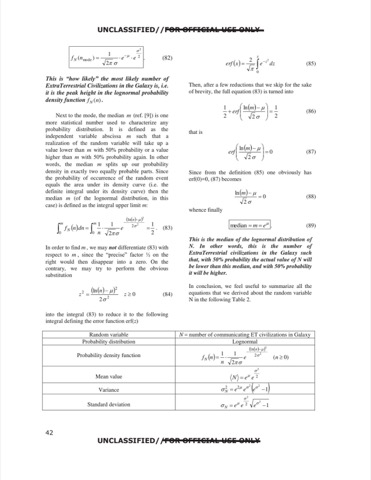
Image from page 42 of DOW-UAP-D127, as released by war.gov
Image from page 42 of the PDF. Open the scan to see the whole page.

Cite this page

U.S. Department of War. "AAWSAP DIRD, An Introduction to the Statistical Drake Equation, March 2010" (DOW-UAP-D127). PURSUE Release 06, U.S. Department of War, September 18, 2026. https://www.war.gov/medialink/ufo/sept-18/release-06/assets/DOW-UAP-D127_AAWSAP-DIRD-An-Introduction-to-the-Statistical-Drake-Equation-March-11-2010.pdf. Declassified UAP, page 42, https://declassifieduap.org/r/dow-uap-d127-aawsap-dird-an-introduction-to-the-statistical-drake-equation-march-2010/p/42. Accessed November 28, 2026.

This address shows page 42 on its own; /r/dow-uap-d127-aawsap-dird-an-introduction-to-the-statistical-drake-equation-march-2010?page=42 opens the same page in the full reader. Both stay. How to cite.