DOW-UAP-D127

AAWSAP DIRD, An Introduction to the Statistical Drake Equation, March 2010, page 40

One page of a U.S. government record released under PURSUE, shown on its own with its text. The record page has the whole document, its catalog details and the scan.

Page
40 of 55
Agency
Department of War
Released
Release 06, September 18, 2026

Text of page 40

UNCLASSIFIED/ /FeR OFFICIAL USE ONLY In the sequel of this paper we shall denote the independent variable of the lognormal distribution (47) by a lower case letter n to remind the reader that corresponding random variable N is the positive integer number of ExtraTerrestrial Civilizations in the Galaxy. In other words, n will be treated as a positive real number in all calculations to follow because it is a "large" number (i.e. a continuous variable) compared to the only civilization that we know of, i.e. ourselves. In conclusion, from now on the lognormal probability density function of N will be written as 1 fN (n) = 1 - e V2TO (In(n) -4) 2đ (n ≥ 0) (56) Having so said, we now turn to the statistical properties of the lognormal distribution (55), i.e. to the statistical properties that describe the number N of ExtraTerrestrial Civilizations in the Galaxy. Our first goal is to prove an equation yielding all the moments of the lognormal distribution (56), that is, for every non-negative integer k = 0, 1, 2, ... one has NK 12.0 e 2 (57) The relevant proof starts with the definition of the k- th moment Upon setting k = 0 into (56), normalization condition for f~(n) follows the (59) Upon setting k=1 into (56), the important mean value of the random variable N is found (N) =e" e ? (60) Upon setting k = 2 into (56), the mean value of the square of the random variable N is found (Nº) = 2ơ. (61) The variance of N now follows from the last two formulae: 0) =221 e (62) The square root of this is the important standard deviation formula for the N random variable (63) The third moment is obtained upon setting k = 3 into (56) 202 • e dn n V210 One then transforms the above integral by virtue of the substitution In[n] = z. (58) The new integral in z is then seen to reduce to the Gaussian integral (53) (we skip all steps here) and (57) follows 12.02 = eku e Finally, upon setting k = 4, the fourth moment of N is found (N*) =e*' 80? Our next goal is to find the cumulants of N. In principle, we could compute all the cumulants K; from the generic i-th moment i, by virtue of the recursion formula (see ref. [8]) (64) (65) (66) 40 UNCLASSIFIED/ TOR OFFICIAL USE ONLY

Machine-read (OCR) from the scan by this archive; it can contain errors. The scan is the record.
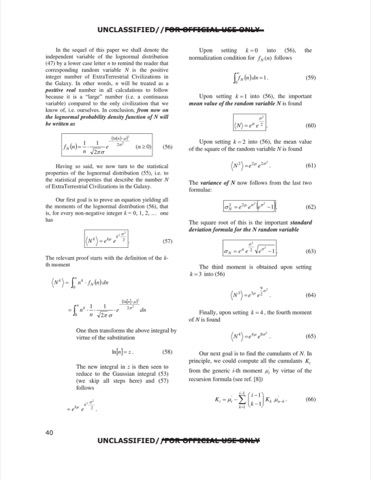
Image from page 40 of DOW-UAP-D127, as released by war.gov
Image from page 40 of the PDF. Open the scan to see the whole page.

Cite this page

U.S. Department of War. "AAWSAP DIRD, An Introduction to the Statistical Drake Equation, March 2010" (DOW-UAP-D127). PURSUE Release 06, U.S. Department of War, September 18, 2026. https://www.war.gov/medialink/ufo/sept-18/release-06/assets/DOW-UAP-D127_AAWSAP-DIRD-An-Introduction-to-the-Statistical-Drake-Equation-March-11-2010.pdf. Declassified UAP, page 40, https://declassifieduap.org/r/dow-uap-d127-aawsap-dird-an-introduction-to-the-statistical-drake-equation-march-2010/p/40. Accessed November 28, 2026.

This address shows page 40 on its own; /r/dow-uap-d127-aawsap-dird-an-introduction-to-the-statistical-drake-equation-march-2010?page=40 opens the same page in the full reader. Both stay. How to cite.