DOW-UAP-D127

AAWSAP DIRD, An Introduction to the Statistical Drake Equation, March 2010, page 30

One page of a U.S. government record released under PURSUE, shown on its own with its text. The record page has the whole document, its catalog details and the scan.

Page
30 of 55
Agency
Department of War
Released
Release 06, September 18, 2026

Text of page 30

UNCLASSIFIED/ / FOR OFFICIAL USE ONLY ref. [5]. The advantage of this notation is that it makes a neat distinction between probabilistic (or statistical: it's the same thing here) variables, always denoted by capitals, from non-probabilistic (or "deterministic") variables, always denoted by lower-case letters. Adopting the Papoulis notation also is a tribute to him by this author, who was a Fulbright Grantee in the United States with him at the Polytechnic Institute (now Polytechnic University) of New York in the years 1977-78-79. We thus introduce seven new (positive) random variables D; ("D" from "Drake") defined as (3) D, = Ns D2 = fp Dz, = ne D4 = fl D, = fi D6 = fc (D, = fL (2) so that our STATISTICAL Drake equation may be simply rewritten as i=1 Of course, N now becomes a (positive) random variable too, having its own (positive) mean value and standard deviation. Just as each of the D; has its own (positive) mean value and standard deviation... ... the natural question then arises: how are the seven mean values on the right related to the mean value on the left? .. and how are the seven standard deviations on the right related to the standard deviation on the left? Just take the next step... cri STEP 2: INTRODUCING LOGS TO CHANGE THE PRODUCT INTO A SUM Products of random variables are not easy to handle in probability theory. It is actually much easier to handle sums of random variables, rather than products, because: The probability density of the sum of two or more independent random variables is the convolution of the relevant probability densities (worry not about the equations, right now). 2) The Fourier transform of the convolution simply is the product of the Fourier transforms (again, worry not about the equations, at this point) 30 UNCLASSIFIED/ FOR OFFICIAL USE ONLY

Machine-read (OCR) from the scan by this archive; it can contain errors. The scan is the record.
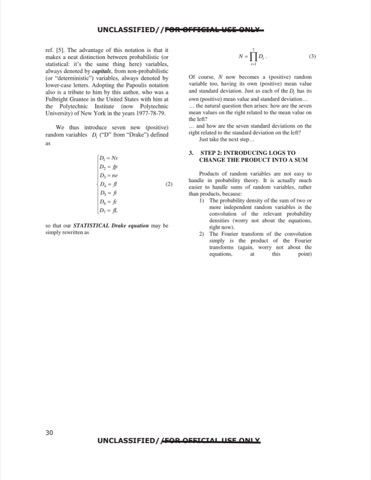
Image from page 30 of DOW-UAP-D127, as released by war.gov
Image from page 30 of the PDF. Open the scan to see the whole page.

Cite this page

U.S. Department of War. "AAWSAP DIRD, An Introduction to the Statistical Drake Equation, March 2010" (DOW-UAP-D127). PURSUE Release 06, U.S. Department of War, September 18, 2026. https://www.war.gov/medialink/ufo/sept-18/release-06/assets/DOW-UAP-D127_AAWSAP-DIRD-An-Introduction-to-the-Statistical-Drake-Equation-March-11-2010.pdf. Declassified UAP, page 30, https://declassifieduap.org/r/dow-uap-d127-aawsap-dird-an-introduction-to-the-statistical-drake-equation-march-2010/p/30. Accessed November 28, 2026.

This address shows page 30 on its own; /r/dow-uap-d127-aawsap-dird-an-introduction-to-the-statistical-drake-equation-march-2010?page=30 opens the same page in the full reader. Both stay. How to cite.