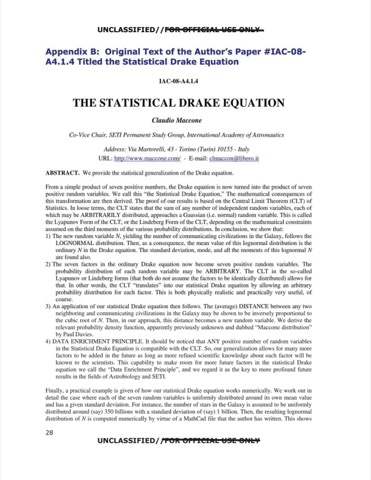
Text of page 28
UNCLASSIFIED/ / FOR OFFICIAL USE ONLY
Appendix B: Original Text of the Author's Paper #IAC-08-
A4.1.4 Titled the Statistical Drake Equation
IAC-08-A4.1.4
THE STATISTICAL DRAKE EQUATION
Claudio Maccone
Co-Vice Chair, SETI Permanent Study Group, International Academy of Astronautics
Address: Via Martorelli, 43 - Torino (Turin) 10155 - Italy
URL: http://www.maccone.com/ - E-mail: clmaccon@libero.it
ABSTRACT. We provide the statistical generalization of the Drake equation.
From a simple product of seven positive numbers, the Drake equation is now turned into the product of seven
positive random variables. We call this "the Statistical Drake Equation," The mathematical consequences of
this transformation are then derived. The proof of our results is based on the Central Limit Theorem (CLT) of
Statistics. In loose terms, the CLT states that the sum of any number of independent random variables, each of
which may be ARBITRARILY distributed, approaches a Gaussian (i.e. normal) random variable. This is called
the Lyapunov Form of the CLT, or the Lindeberg Form of the CLT, depending on the mathematical constraints
assumed on the third moments of the various probability distributions. In conclusion, we show that:
1) The new random variable N, yielding the number of communicating civilizations in the Galaxy, follows the
LOGNORMAL distribution. Then, as a consequence, the mean value of this lognormal distribution is the
ordinary N in the Drake equation. The standard deviation, mode, and all the moments of this lognormal N
are found also.
that. In other words, the CLT "translates" into our statistical Drake equation by allowing an arbitrary
probability distribution for each factor. This is both physically realistic and practically very useful, of
course.
3) An application of our statistical Drake equation then follows. The (average) DISTANCE between any two
neighboring and communicating civilizations in the Galaxy may be shown to be inversely proportional to
the cubic root of N. Then, in our approach, this distance becomes a new random variable. We derive the
relevant probability density function, apparently previously unknown and dubbed "Maccone distribution"
by Paul Davies.
4) DATA ENRICHMENT PRINCIPLE. It should be noticed that ANY positive number of random variables
in the Statistical Drake Equation is compatible with the CLT. So, our generalization allows for many more
factors to be added in the future as long as more refined scientific knowledge about each factor will be
known to the scientists. This capability to make room for more future factors in the statistical Drake
equation we call the "Data Enrichment Principle", and we regard it as the key to more profound future
results in the fields of Astrobiology and SETI.
Finally, a practical example is given of how our statistical Drake equation works numerically. We work out in
detail the case where each of the seven random variables is uniformly distributed around its own mean value
and has a given standard deviation. For instance, the number of stars in the Galaxy is assumed to be uniformly
distributed around (say) 350 billions with a standard deviation of (say) 1 billion. Then, the resulting lognormal
distribution of N is computed numerically by virtue of a MathCad file that the author has written. This shows
28
UNCLASSIFIED/ /TOR OFFICIAL USE ONLY