DOW-UAP-D127

AAWSAP DIRD, An Introduction to the Statistical Drake Equation, March 2010, page 22

One page of a U.S. government record released under PURSUE, shown on its own with its text. The record page has the whole document, its catalog details and the scan.

Page
22 of 55
Agency
Department of War
Released
Release 06, September 18, 2026

Text of page 22

UNCLASSIFIED/ /FeR OFFICIAL USE ONLY It is clarifying to draw the graph of the ET_Distance probability density (9): 5.63•10-20 DISTANCE OF NEAREST ET_CIVILIZATION 4.5•10-20 Probability density function (1/meters) 3.38•10-20 2.25 •10-20 1.13•10-20 0 0 500 1000 1500 2000 2500 3000 3500 4000 4500 5000 ET_Distance from Earth (light years) Figure 3. The Probability of Finding the Nearest Extraterrestrial Civilization at the distance r From Earth (in light years) if the Values Assumed in the Drake Equation are Those Shown in Input Table 1. The relevant probability density function fET Distance (r) is given by equation (9). Its mode (peak abscissa) equals 1933 light years, but its mean value is higher since the curve has a long tail on the right: the mean value equals in fact 2670 light years. Finally, the standard deviation equals 1309 light years: THIS IS GOOD NEWS FOR SETI, inasmuch as the nearest ET galaxy civilization might lie at just 1 sigma = 2670-1309 = 1361 light years from us. From Figure 3 we see that the probability of finding extraterrestrials is practically zero up to a distance of about 500 light years from Earth. Then it starts increasing with the increasing distance from Earth, and reaches its maximum at 'mode = Ipeak = Ce 3 e 9 ≥ 1,933 light years. This is the MOST LIKELY VALUE of the distance at which we can expect to find the nearest extraterrestrial civilization. (14) It is not the mean value of the probability distribution (9) for fET Distane (r). In fact, the probability density (9) has an infinite tail on the right, as clearly shown in Figure 3, and hence its mean value must be higher than its peak value. As given by (10) and (12), its mean value is mean_ value = Ce 3 e 18 ≥ 2670 light years. This is the MEAN (value of the) DISTANCE at which we can expect to find extraterrestrials. 22 UNCLASSIFIED/+FOR OFFICIAL USE ONLY

Machine-read (OCR) from the scan by this archive; it can contain errors. The scan is the record.
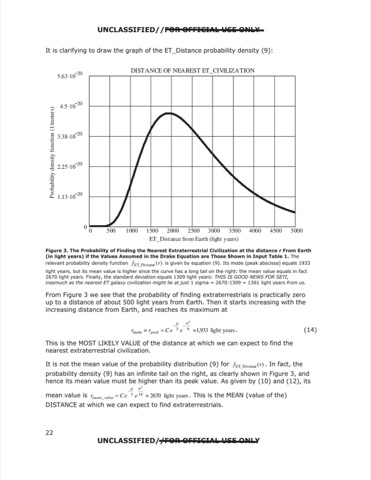
Image from page 22 of DOW-UAP-D127, as released by war.gov
Image from page 22 of the PDF. Open the scan to see the whole page.

Cite this page

U.S. Department of War. "AAWSAP DIRD, An Introduction to the Statistical Drake Equation, March 2010" (DOW-UAP-D127). PURSUE Release 06, U.S. Department of War, September 18, 2026. https://www.war.gov/medialink/ufo/sept-18/release-06/assets/DOW-UAP-D127_AAWSAP-DIRD-An-Introduction-to-the-Statistical-Drake-Equation-March-11-2010.pdf. Declassified UAP, page 22, https://declassifieduap.org/r/dow-uap-d127-aawsap-dird-an-introduction-to-the-statistical-drake-equation-march-2010/p/22. Accessed November 28, 2026.

This address shows page 22 on its own; /r/dow-uap-d127-aawsap-dird-an-introduction-to-the-statistical-drake-equation-march-2010?page=22 opens the same page in the full reader. Both stay. How to cite.