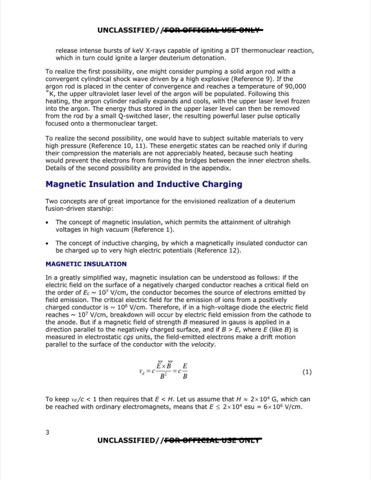
Text of page 9
UNCLASSIFIED//FOR OFF
AL USE ONLY
release intense bursts of kev X-rays capable of igniting a DT thermonuclear reaction,
which in turn could ignite a larger deuterium detonation.
To realize the first possibility, one might consider pumping a solid argon rod with a
convergent cylindrical shock wave driven by a high explosive (Reference 9). If the
argon rod is placed in the center of convergence and reaches a temperature of 90,000
°K, the upper ultraviolet laser level of the argon will be populated. Following this
heating, the argon cylinder radially expands and cools, with the upper laser level frozen
into the argon. The energy thus stored in the upper laser level can then be removed
from the rod by a small Q-switched laser, the resulting powerful laser pulse optically
focused onto a thermonuclear target.
To realize the second possibility, one would have to subject suitable materials to very
high pressure (Reference 10, 11). These energetic states can be reached only if during
their compression the materials are not appreciably heated, because such heating
would prevent the electrons from forming the bridges between the inner electron shells.
Details of the second possibility are provided in the appendix.
Magnetic Insulation and Inductive Charging
Two concepts are of great importance for the envisioned realization of a deuterium
fusion-driven starship:
• The concept of magnetic insulation, which permits the attainment of ultrahigh
voltages in high vacuum (Reference 1).
• The concept of inductive charging, by which a magnetically insulated conductor can
be charged up to very high electric potentials (Reference 12).
MAGNETIC INSULATION
In a greatly simplified way, magnetic insulation can be understood as follows: if the
electric field on the surface of a negatively charged conductor reaches a critical field on
the order of Ec ~ 107 V/cm, the conductor becomes the source of electrons emitted by
field emission. The critical electric field for the emission of ions from a positively
charged conductor is ~ 108 V/cm. Therefore, if in a high-voltage diode the electric field
reaches ~ 107 V/cm, breakdown will occur by electric field emission from the cathode to
the anode. But if a magnetic field of strength B measured in gauss is applied in a
direction parallel to the negatively charged surface, and if B > E, where E (like B) is
measured in electrostatic cgs units, the field-emitted electrons make a drift motion
parallel to the surface of the conductor with the velocity.
V, = C-
(1)
B
To keep va/c < 1 then requires that E < H. Let us assume that H ≥ 2x10⁴ G, which can
be reached with ordinary electromagnets, means that E ≤ 2x10⁴ esu = 6x10⁶ V/cm.
3
UNCLASSIFIED//FOR eFFIETAL USE ONLY