Text of page 32
UNCLASSIFIED/ FOR OFFICIAL USE ONLY
Appendix: Conjectured Metastable Superexplosives
Formed Under High Pressure for Thermonuclear Ignition
Under normal pressure, the distance of separation between two atoms in condensed
matter is typically on the order of 10-8 cm, with the distance between molecules formed
by the chemical binding of atoms of the same order of magnitude. As illustrated
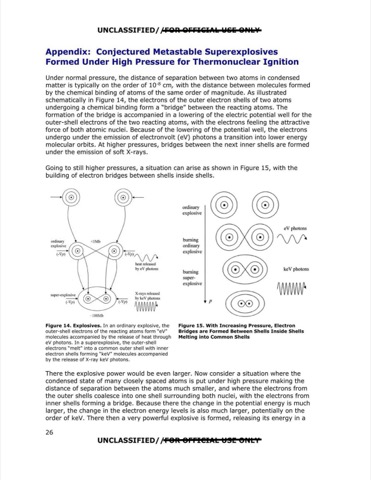
schematically in Figure 14, the electrons of the outer electron shells of two atoms
undergoing a chemical binding form a "bridge" between the reacting atoms. The
formation of the bridge is accompanied in a lowering of the electric potential well for the
outer-shell electrons of the two reacting atoms, with the electrons feeling the attractive
force of both atomic nuclei. Because of the lowering of the potential well, the electrons
undergo under the emission of electronvolt (eV) photons a transition into lower energy
molecular orbits. At higher pressures, bridges between the next inner shells are formed
under the emission of soft X-rays.
Going to still higher pressures, a situation can arise as shown in Figure 15, with the
building of electron bridges between shells inside shells.
ordinary
explosive
eV photons
ordinary
explosive
(-Vp)
<IMb
(-Vp)
burning
ordinary
explosive
heat released
by eV photons
burning
super-
explosive
keV photons
www.
super-explosive
(-Vp)
(-Vp)
X-rays released
by keV photons
www.
- 100Mb
Figure 14. Explosives. In an ordinary explosive, the
outer-shell electrons of the reacting atoms form "eV"
molecules accompanied by the release of heat through
eV photons. In a superexplosive, the outer-shell
electrons "melt" into a common outer shell with inner
electron shells forming "keV" molecules accompanied
by the release of X-ray keV photons.
Figure 15. With Increasing Pressure, Electron
Bridges are Formed Between Shells Inside Shells
Melting into Common Shells
There the explosive power would be even larger. Now consider a situation where the
condensed state of many closely spaced atoms is put under high pressure making the
distance of separation between the atoms much smaller, and where the electrons from
the outer shells coalesce into one shell surrounding both nuclei, with the electrons from
inner shells forming a bridge. Because there the change in the potential energy is much
larger, the change in the electron energy levels is also much larger, potentially on the
order of keV. There then a very powerful explosive is formed, releasing its energy in a
26
UNCLASSIFIED//FOR OFFICIAL USE ONLY