Text of page 70
UNCLASSIFIED//FOR
AL USE ONIX
These studies did not yet include differential pumping so that number of recirculation
passes by an ion, B, was low, roughly 2, due to major charge exchange losses. The
injected ion current, I, with one gun was only ~ 50 mA. Still, based on measurements
of neutrons emitted using deuterium fuel, the Q (fusion energy gain/energy in) was
order of 10-6 which is remarkable for such a small device. These results, plus supporting
computer simulation studies, show that the scale-up of this device to 12 injector guns
plus adding strong differential pumping, could potentially achieve breakeven.
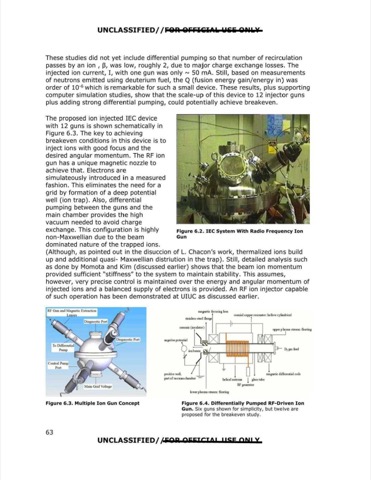
The proposed ion injected IEC device
with 12 guns is shown schematically in
Figure 6.3. The key to achieving
breakeven conditions in this device is to
inject ions with good focus and the
desired angular momentum. The RF ion
gun has a unique magnetic nozzle to
achieve that. Electrons are
simulateously introduced in a measured
fashion. This eliminates the need for a
grid by formation of a deep potential
well (ion trap). Also, differential
pumping between the guns and the
main chamber provides the high
vacuum needed to avoid charge
exchange. This configuration is highly
Figure 6.2. IEC System With Radio Frequency Ion
non-Maxwellian due to the beam
Gun
dominated nature of the trapped ions.
(Although, as pointed out in the disuccion of L. Chacon's work, thermalized ions build
up and additional quasi- Maxwellian distriution in the trap). Still, detailed analysis such
as done by Momota and Kim (discussed earlier) shows that the beam ion momentum
provided sufficient "stiffness" to the system to maintain stability. This assumes,
however, very precise control is maintained over the energy and angular momentum of
injected ions and a balanced supply of electrons is provided. An RF ion injector capable
of such operation has been demonstrated at UIUC as discussed earlier.
RF Gun and Magnetic Extraction
Lenses
Diagnostic Port
magnetic focusing lens
stainless steel flange
ceramic (insulator)
coaxial copper resonator: hollow cylindrical
upper plasma stream: floating
Diagnostic Port
negative potential
To Differential
Pump
Central Pump
Port
babeam
D, gas feed
positive wall,
part of vacuumchamber
magnetic differestial coils
Main Grid Voltage
Figure 6.3. Multiple Ion Gun Concept
helical antenna
glass tube
RE generator
lower plasma steam: floating
Figure 6.4. Differentially Pumped RF-Driven Ion
Gun. Six guns shown for simplicity, but twelve are
proposed for the breakeven study.
63
UNCLASSIFIED/ /FOR OFFICIAL ILSE ONLY