DOW-UAP-D125

AAWSAP DIRD, Inertial Electrostatic Confinement Fusion, March 2010, page 55

One page of a U.S. government record released under PURSUE, shown on its own with its text. The record page has the whole document, its catalog details and the scan.

Page
55 of 72
Agency
Department of War
Released
Release 06, September 18, 2026

Text of page 55

UNCLASSIFIED/ /POR OF At UsE ONtY The three detection techniques shown in Table 5.1 have previously been used independently in inspection units. The present integrated unit makes use of all three simultaneously. Thus, the strengths of each device combine to provide consistent overall coverage of elements/objects. Table 5.1. Three Kinds of Techniques Previously Used in Explosives Detection System Here, TNA and FNA represent thermal and fast neutron activation, respectively. TNA ENA Element Identification X-ray Element Density Nitrogen Carbon Oxygen Hydrogen Chlorine C/O Ratio Background Noise High Very Low NA Very High Very High NA High Imaging: geometry & localization Limited information Application Small suitcase Configuration Operation & Maintenance Cost Complicated High Medium Very High High High High High Low Pulsed FNA provides depth information Suitcase to cargo Complicated High NA High resolution Suitcase to cargo, not good for plastics objects Simple Low The integrated IEC system employs a combination of PNA/TNA methods and conventional x-ray techniques to collect elemental information as well as a 3-D imaging of any suspected objects. The 14.1-MeV neutrons from the D-T reaction will be the primary source for TOF FNA while thermalized neutrons from a block of neutron thermalizing plastic in front of the 2.45-MeV DD IEC will be used for TNA. This combination will increase spatial resolution and significantly reduce the false alarm rate to a low level compared to conventional methods which employ single sources and are limited to yield due to lack of broad area sources. Overview for Weapons/Nuclear Material Simulation Articles The following three categories of items provide a overview of articles of interest for detection in inspection stations. A. Explosives which are of high 0 and N, low C and H elemental densities are listed below with sizes ranging from 8 x 8 x 8 cm3 to 20 x 20 x 20 cm3. • RDX (Cyclonite, CH6N606) with p = 1.83 g/ст3. • TNT(Trinitrotoluene, C>H5N306) with p = 1.654 g/cm3. • PETN(Penthrite, CsHsN4012) with p = 1.773 g/cm 3. • TATB(Triaminotrinitrobenzene, C6H6N606) with p = 1.93 g/ст3. 48 UNCLASSIFIED//FOR OFFICIAL USE ONLY

Machine-read (OCR) from the scan by this archive; it can contain errors. The scan is the record.
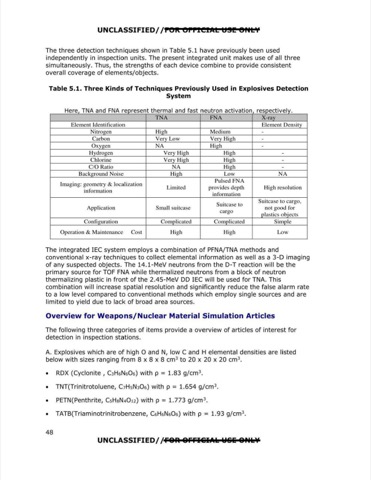
Image from page 55 of DOW-UAP-D125, as released by war.gov
Image from page 55 of the PDF. Open the scan to see the whole page.

Cite this page

U.S. Department of War. "AAWSAP DIRD, Inertial Electrostatic Confinement Fusion, March 2010" (DOW-UAP-D125). PURSUE Release 06, U.S. Department of War, September 18, 2026. https://www.war.gov/medialink/ufo/sept-18/release-06/assets/DOW-UAP-D125_AAWSA-DIRD-Inertial-Electrostatic-Confinement-Fusion-March-10-2010.pdf. Declassified UAP, page 55, https://declassifieduap.org/r/dow-uap-d125-aawsap-dird-inertial-electrostatic-confinement-fusion-march-2010/p/55. Accessed November 28, 2026.

This address shows page 55 on its own; /r/dow-uap-d125-aawsap-dird-inertial-electrostatic-confinement-fusion-march-2010?page=55 opens the same page in the full reader. Both stay. How to cite.