Text of page 52
UNCLASSIFIED/ /FOR eFFIeIAL USE ONLY
gridded IECs. Further, the model provides more insight into operation in the STAR
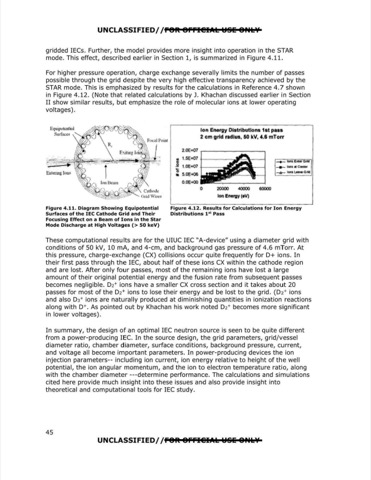
mode. This effect, described earlier in Section 1, is summarized in Figure 4.11.
For higher pressure operation, charge exchange severally limits the number of passes
possible through the grid despite the very high effective transparency achieved by the
STAR mode. This is emphasized by results for the calculations in Reference 4.7 shown
in Figure 4.12. (Note that related calculations by J. Khachan discussed earlier in Section
Il show similar results, but emphasize the role of molecular ions at lower operating
voltages).
Equipotential
Surfices
Ion Energy Distributions 1st pass
Focal Point
2 cm grid radius, 50 kV, 4.6 mTorr
Exiting Ions,
Entering logs
Ion Beum
2.0+07
# of ions
1.5E +07
1.0E+07
5.0E+06
0.0E +00
+ lans Enter Grid
tons at Center
- lens Leave Grid
Catinde
Grid Wires
20000
40000
Ion Energy (eV)
60000
Figure 4.11. Diagram Showing Equipotential
Surfaces of the IEC Cathode Grid and Their
Focusing Effect on a Beam of Ions in the Star
Mode Discharge at High Voltages (> 50 keV)
Figure 4.12. Results for Calculations for Ion Energy
Distributions 1st Pass
These computational results are for the UIUC IEC "A-device" using a diameter grid with
conditions of 50 kV, 10 mA, and 4-cm, and background gas pressure of 4.6 mTorr. At
this pressure, charge-exchange (CX) collisions occur quite frequently for D+ ions. In
their first pass through the IEC, about half of these ions CX within the cathode region
and are lost. After only four passes, most of the remaining ions have lost a large
amount of their original potential energy and the fusion rate from subsequent passes
becomes negligible. De ions have a smaller CX cross section and it takes about 20
passes for most of the D2* ions to lose their energy and be lost to the grid. (D2+ ions
and also D3 ions are naturally produced at diminishing quantities in ionization reactions
along with D+. As pointed out by Khachan his work noted D2+ becomes more significant
in lower voltages).
In summary, the design of an optimal IEC neutron source is seen to be quite different
from a power-producing IEC. In the source design, the grid parameters, grid/vessel
diameter ratio, chamber diameter, surface conditions, background pressure, current,
and voltage all become important parameters. In power-producing devices the ion
injection parameters-- including ion current, ion energy relative to height of the well
potential, the ion angular momentum, and the ion to electron temperature ratio, along
with the chamber diameter ---determine performance. The calculations and simulations
cited here provide much insight into these issues and also provide insight into
theoretical and computational tools for IEC study.
45
UNCLASSIFIED//FOR OFFICIAL USE ONLY