DOW-UAP-D125

AAWSAP DIRD, Inertial Electrostatic Confinement Fusion, March 2010, page 44

One page of a U.S. government record released under PURSUE, shown on its own with its text. The record page has the whole document, its catalog details and the scan.

Page
44 of 72
Agency
Department of War
Released
Release 06, September 18, 2026

Text of page 44

UNCLASSIFIED// 20 Y 40₽ 80 60 1600 500 Q 400 130. 10 500 300 Smax [a] 200 100 400 300 200 Smax [6] E, (keV) 150 100 200 100 380 0.120 20 - 0.1 Q 10 0.05 0 500 100 400 200 300 S max 200 100 300 400 500 max Icl Idl Figure 4.3. Plot of the Q-value (including electron losses) as a Function of (a) Smax and y with fe=103, (b) §max and fe with y = 5, (c) Smax and fe with y = 100, and (d) Smax and Eo with y= 5 and f. =10-3. These plots have been obtained for Eo =100 keV [except (d)], 0b =0.01, and Ês =1.04. (Nomenclature is defined in Reference 4.2). The source to sink issue noted several times here can be explained as follows. Two opposite limits of this kind of solution are depicted in Figure 4.4. The realization of either of these limits depends on the equilibrium between two competing effects, namely up-scattering of the Maxwellian ion component confined in the well (which increases as the Maxwellian temperature increases and tends to empty the well), and down-scattering of the beam (which tends to fill it). The relative importance of these effects is directly related to the strength relatives of the source and the sink. They are characterized here by Smax = maximum value of the ion source, and t = ion replacement time, respectively. Thus, weak sinks and strong sources will result in a large beam population, increasing the beam down-scattering rate and hence increasing "effective" Maxwellian temperature, given in the dotted line profile in Figure 4.4. Conversely, weak sources and strong sinks will result in a small beam population, thus decreasing the beam down-scattering rate and resulting in lower Maxwellian temperatures, leading to the solid line profile in Figure 4.4. 37 UNCLASSIFIED//FOR OFFICIAL USE ONLY

Machine-read (OCR) from the scan by this archive; it can contain errors. The scan is the record.
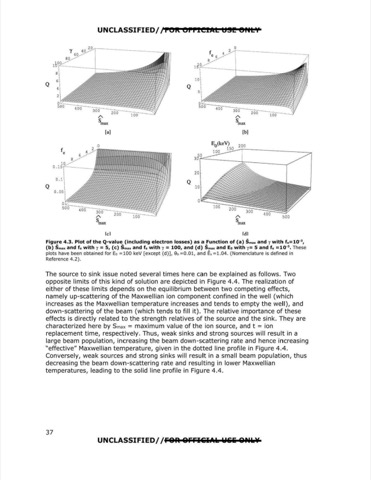
Image from page 44 of DOW-UAP-D125, as released by war.gov
Image from page 44 of the PDF. Open the scan to see the whole page.

Cite this page

U.S. Department of War. "AAWSAP DIRD, Inertial Electrostatic Confinement Fusion, March 2010" (DOW-UAP-D125). PURSUE Release 06, U.S. Department of War, September 18, 2026. https://www.war.gov/medialink/ufo/sept-18/release-06/assets/DOW-UAP-D125_AAWSA-DIRD-Inertial-Electrostatic-Confinement-Fusion-March-10-2010.pdf. Declassified UAP, page 44, https://declassifieduap.org/r/dow-uap-d125-aawsap-dird-inertial-electrostatic-confinement-fusion-march-2010/p/44. Accessed November 28, 2026.

This address shows page 44 on its own; /r/dow-uap-d125-aawsap-dird-inertial-electrostatic-confinement-fusion-march-2010?page=44 opens the same page in the full reader. Both stay. How to cite.