Text of page 35
UNCLASSIFIED/ / FOR eFFICIAL USE ONLY
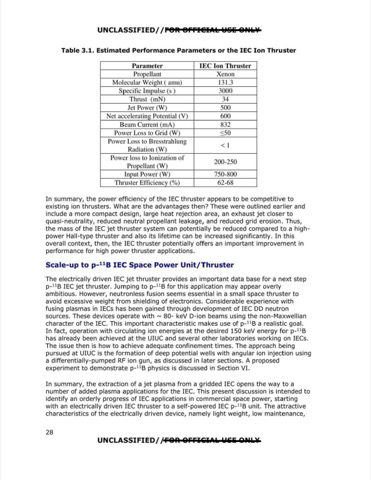
Table 3.1. Estimated Performance Parameters or the IC Ion Thruster
Parameter
Propellant
Molecular Weight (amu)
Specific Impulse (s)
Thrust (mN)
Jet Power (W)
Net accelerating Potential (V)
Beam Current (mA)
Power Loss to Grid (W)
Power Loss to Bresstrahlung
Radiation (W)
Power loss to lonization of
Propellant (W)
Input Power (W)
Thruster Efficiency (%)
IEC Ion Thruster
Xenon
131.3
3000
34
500
600
832
≤50
<1
200-250
750-800
62-68
In summary, the power efficiency of the IEC thruster appears to be competitive to
existing ion thrusters. What are the advantages then? These were outlined earlier and
include a more compact design, large heat rejection area, an exhaust jet closer to
quasi-neutrality, reduced neutral propellant leakage, and reduced grid erosion. Thus,
the mass of the IC jet thruster system can potentially be reduced compared to a high-
power Hall-type thruster and also its lifetime can be increased significantly. In this
overall context, then, the IEC thruster potentially offers an important improvement in
performance for high power thruster applications.
Scale-up to p-11B IEC Space Power Unit /Thruster
The electrically driven IEC jet thruster provides an important data base for a next step
p-11B IEC jet thruster. Jumping to p-11B for this application may appear overly
ambitious. However, neutronless fusion seems essential in a small space thruster to
avoid excessive weight from shielding of electronics. Considerable experience with
fusing plasmas in IECs has been gained through development of IEC DD neutron
sources. These devices operate with ~ 80- keV D-ion beams using the non-Maxwellian
character of the IEC. This important characteristic makes use of p-11B a realistic goal.
In fact, operation with circulating ion energies at the desired 150 keV energy for p-11B
has already been achieved at the UIUC and several other laboratories working on IECs.
The issue then is how to achieve adequate confinement times. The approach being
pursued at UIUC is the formation of deep potential wells with angular ion injection using
a differentially-pumped RF ion gun, as discussed in later sections. A proposed
experiment to demonstrate p-11B physics is discussed in Section VI.
In summary, the extraction of a jet plasma from a gridded IEC opens the way to a
number of added plasma applications for the IEC. This present discussion is intended to
identify an orderly progress of IEC applications in commercial space power, starting
with an electrically driven IEC thruster to a self-powered IEC p-11B unit. The attractive
characteristics of the electrically driven device, namely light weight, low maintenance,
28
UNCLASSIFIED//FOR
AL USE ONLY