Text of page 13
UNCLASSIFIED//FOR OFFICIAL USE ONLY
104
103
102
NORMALIZED ION DENSITY -
10l
VIRTUAL: ANODE
VIRTUAL CATHODE
VIRTUAL
REAL CATHODE
100
0. 2
0.4
0.6
a.g
RABIUS
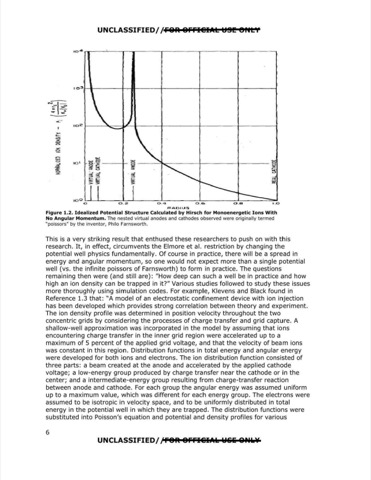
Figure 1.2. Idealized Potential Structure Calculated by Hirsch for Monoenergetic Ions With
No Angular Momentum. The nested virtual anodes and cathodes observed were originally termed
"poissors" by the inventor, Philo Farnsworth.
This is a very striking result that enthused these researchers to push on with this
research. It, in effect, circumvents the Elmore et al. restriction by changing the
potential well physics fundamentally. Of course in practice, there will be a spread in
energy and angular momentum, so one would not expect more than a single potential
well (vs. the infinite poissors of Farnsworth) to form in practice. The questions
remaining then were (and still are): "How deep can such a well be in practice and how
high an ion density can be trapped in it?" Various studies followed to study these issues
more thoroughly using simulation codes. For example, Klevens and Black found in
Reference 1.3 that: "A model of an electrostatic confinement device with ion injection
has been developed which provides strong correlation between theory and experiment.
The ion density profile was determined in position velocity throughout the two
concentric grids by considering the processes of charge transfer and grid capture. A
shallow-well approximation was incorporated in the model by assuming that ions
encountering charge transfer in the inner grid region were accelerated up to a
maximum of 5 percent of the applied grid voltage, and that the velocity of beam ions
was constant in this region. Distribution functions in total energy and angular energy
were developed for both ions and electrons. The ion distribution function consisted of
three parts: a beam created at the anode and accelerated by the applied cathode
voltage; a low-energy group produced by charge transfer near the cathode or in the
center; and a intermediate-energy group resulting from charge-transfer reaction
between anode and cathode. For each group the angular energy was assumed uniform
up to a maximum value, which was different for each energy group. The electrons were
assumed to be isotropic in velocity space, and to be uniformly distributed in total
energy in the potential well in which they are trapped. The distribution functions were
substituted into Poisson's equation and potential and density profiles for various
6
UNCLASSIFIED//FOR 9FF€ZA\-USE-@AL·