DOW-UAP-D124

AAWSAP DIRD, Space Access: Where We’ve Been and Where We Could Go, March 2010, page 54

One page of a U.S. government record released under PURSUE, shown on its own with its text. The record page has the whole document, its catalog details and the scan.

Page
54 of 56
Agency
Department of War
Released
Release 06, September 18, 2026

Text of page 54

UNCLASSIFIED/ FOR OFFICIAL USE ONLY Appendix C: TAV Operational Costs Art Robinson was the deputy program manager for the MDC Manned Aerospace Vehicle Group at MDC Astronautics, Huntington Beach. Working with Art, the St. Louis part of the team prepared a work breakdown structure for servicing and maintaining an Air Force transatmospheric vehicle (TAV) based on a B-52 squadron. Larry Fogel of Decision Sciences visited several B-52 bases and discussed the operational concept and repair/maintenance work structure with the B-52 crews and maintenance personnel. The result was an estimate of the costs for operating a squadron of TAVs that had the same flight frequency as the B-52 squadron. The result for the one-and-a-half-stage TAV is shown in Figure 45. As might be expected, orbital operations are substantially more costly than atmospheric operations (aerodynamic cruise of hypersonic long-range glide). With an operational range greater than a refueled B-52, the TAV has a lower cost than the once-refueled B-52. The orbital cannot be compared directly with a B-52 since in achieving orbit the TAV has essentially infinite cruise range and duration limited only by the crew. The concept of operations was essentially that shown in Figure 37 installed on a U.S. Air Force SAC base. Although the SAC flight crews concentrated on potential nuclear missions, the presentation focused on a wide spectrum of kinetic penetrators installed in a rocket-accelerated entry nose cone. The terminal speed of the entry nose cone was in the 12,000 to 14,000 feet/second range. At that speed the energy delivered per unit weight was much greater than a spherical charge of HBX-6 because the kinetic energy was directly delivered to the target. The weapons spectrum could address a very wide range of targets that could be disabled or made nonfunctional or be destroyed with minimal collateral damage. Cost $97,000,000 Atmospheric Cruise $251,000,000 Orbital Cost $71,000,000 B-52 only* $140,000,000 Refueled B-52 Larry Fogel Decision Sciences Titan Corporation *annual costs per DAA (14 vehicles) Spring 1984 Figure 45. McDonnell Douglas Astronautics (Huntington Beach)-Funded Study of TAV Operational Costs 47 UNCLASSIFIED/+FOR OFFICIAL USE ONLY

Machine-read (OCR) from the scan by this archive; it can contain errors. The scan is the record.
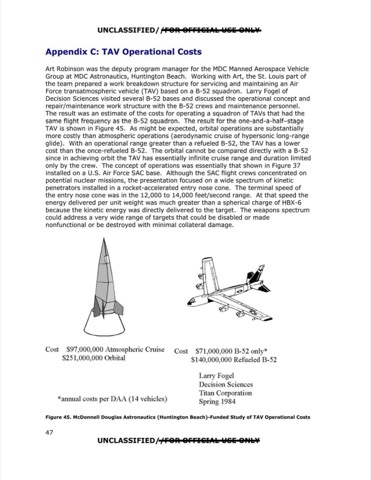
Image from page 54 of DOW-UAP-D124, as released by war.gov
Image from page 54 of the PDF. Open the scan to see the whole page.

Cite this page

U.S. Department of War. "AAWSAP DIRD, Space Access: Where We’ve Been and Where We Could Go, March 2010" (DOW-UAP-D124). PURSUE Release 06, U.S. Department of War, September 18, 2026. https://www.war.gov/medialink/ufo/sept-18/release-06/assets/DOW-UAP-D124_AAWSAP-DIRD-Space%20Access-Where-Weve-Been-and-Where-We-Could-Go-March-8-2010.pdf. Declassified UAP, page 54, https://declassifieduap.org/r/dow-uap-d124-aawsap-dird-space-access-where-weve-been-and-where-we-could-go-march-2010/p/54. Accessed November 28, 2026.

This address shows page 54 on its own; /r/dow-uap-d124-aawsap-dird-space-access-where-weve-been-and-where-we-could-go-march-2010?page=54 opens the same page in the full reader. Both stay. How to cite.