Text of page 44
UNCLASSIFIED/+ F9
oNt
Conclusion
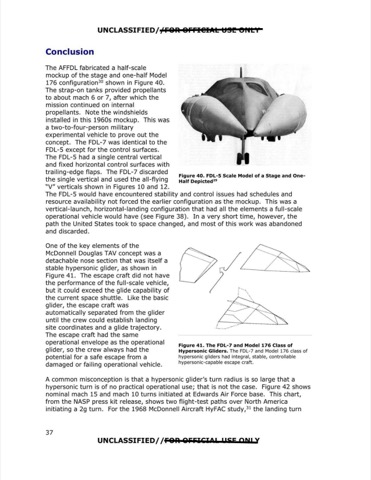
The AFFDL fabricated a half-scale
mockup of the stage and one-half Model
176 configuration30 shown in Figure 40.
The strap-on tanks provided propellants
to about mach 6 or 7, after which the
mission continued on internal
propellants. Note the windshields
installed in this 1960s mockup. This was
a two-to-four-person military
experimental vehicle to prove out the
concept. The FDL-7 was identical to the
FDL-5 except for the control surfaces.
The FDL-5 had a single central vertical
and fixed horizontal control surfaces with
trailing-edge flaps. The FDL-7 discarded
the single vertical and used the all-flying
Figure 40. FDL-5 Scale Model of a Stage and One-
Half Depicted 29
"V" verticals shown in Figures 10 and 12.
The FDL-5 would have encountered stability and control issues had schedules and
resource availability not forced the earlier configuration as the mockup. This was a
vertical-launch, horizontal-landing configuration that had all the elements a full-scale
operational vehicle would have (see Figure 38). In a very short time, however, the
path the United States took to space changed, and most of this work was abandoned
and discarded.
One of the key elements of the
McDonnell Douglas TAV concept was a
detachable nose section that was itself a
stable hypersonic glider, as shown in
Figure 41. The escape craft did not have
the performance of the full-scale vehicle,
but it could exceed the glide capability of
the current space shuttle. Like the basic
glider, the escape craft was
automatically separated from the glider
until the crew could establish landing
site coordinates and a glide trajectory.
The escape craft had the same
operational envelope as the operational
glider, so the crew always had the
potential for a safe escape from a
damaged or failing operational vehicle.
Figure 41. The FDL-7 and Model 176 Class of
Hypersonic Gliders. The FDL-7 and Model 176 class of
hypersonic gliders had integral, stable, controllable
hypersonic-capable escape craft.
A common misconception is that a hypersonic glider's turn radius is so large that a
hypersonic turn is of no practical operational use; that is not the case. Figure 42 shows
nominal mach 15 and mach 10 turns initiated at Edwards Air Force base. This chart,
from the NASP press kit release, shows two flight-test paths over North America
initiating a 2g turn. For the 1968 McDonnell Aircraft HyFAC study, 31 the landing turn
37
UNCLASSIFIED//FOR OFFICIAL USE ONLY