DOW-UAP-D124

AAWSAP DIRD, Space Access: Where We’ve Been and Where We Could Go, March 2010, page 42

One page of a U.S. government record released under PURSUE, shown on its own with its text. The record page has the whole document, its catalog details and the scan.

Page
42 of 56
Agency
Department of War
Released
Release 06, September 18, 2026

Text of page 42

UNCLASSIFIED/ FOR ® AL USE ONLY but we believed new launch complexes would be required to achieve the desired launch rates and to accommodate sustained-use vehicles. This all seems impossible given today's launch operations and preparation time, but in 1964 it was considered possible both in the United States and in the former Soviet Union. It appears that two known companies proposed on the MOL support system, as shown in Figure 38. The Model 176 preliminary launches were to be on a Martin Titan IIIC. This was adequate for testing, but the minimum launches for one year of support of MOL was 74 launches. That 74 Titan IIICs could achieve a sustained manufacturing rate or a sustained launch rate was not considered. So both Lockheed Aircraft and McDonnell Douglas proposed a self-sustained operational system using recoverable lateral propellant tanks. There were no engines on the lateral tanks as there were in the aircraft since they were simply drop tanks. Lockheed Star Clipper circa 1964 McDonnell Douglas Model 176 circa 1964 Figure 38. A 1964 MDC Astronautics, St. Louis, Briefing Defined a MOL Support System With 10 Launchers That Could Fly 100 Missions a Year for 15 Years. Lockheed Aircraft and McDonnell Douglas both had candidates. Atmospheric Variations The published approach to determining glide range is to assume the global atmosphere definition is a series of concentric, constant-density shells. The 1962 standard atmosphere follows the 1959 standard atmosphere and previous standards. NAVAIR-5- 1C-59, Harold Crutchner, 28 details the Northern Hemisphere by month for every 10 degrees of longitude from 1931 to 1964. According to Crutchner, these atmosphere descriptions were not intended to be engineering atmospheres but to be standards to ensure that aircraft flying globally would have adequate altitude clearance. The 1962 atmosphere represents the average of all daily reports by the worldwide reporting stations between +30 and +60 degrees latitude for the spring and fall equinox minus one month to plus one month represented as a +45 degree average atmosphere. 35 UNCLASSIFIED//FOR OFFICIAL USE ONLY

Machine-read (OCR) from the scan by this archive; it can contain errors. The scan is the record.
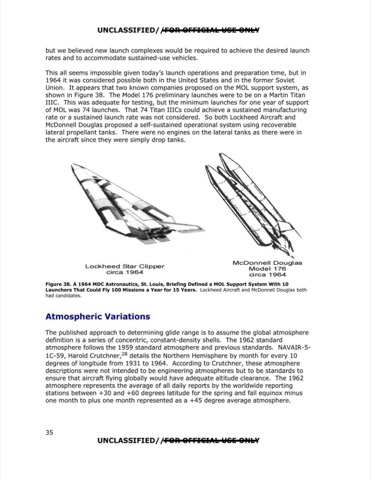
Image from page 42 of DOW-UAP-D124, as released by war.gov
Image from page 42 of the PDF. Open the scan to see the whole page.

Cite this page

U.S. Department of War. "AAWSAP DIRD, Space Access: Where We’ve Been and Where We Could Go, March 2010" (DOW-UAP-D124). PURSUE Release 06, U.S. Department of War, September 18, 2026. https://www.war.gov/medialink/ufo/sept-18/release-06/assets/DOW-UAP-D124_AAWSAP-DIRD-Space%20Access-Where-Weve-Been-and-Where-We-Could-Go-March-8-2010.pdf. Declassified UAP, page 42, https://declassifieduap.org/r/dow-uap-d124-aawsap-dird-space-access-where-weve-been-and-where-we-could-go-march-2010/p/42. Accessed November 28, 2026.

This address shows page 42 on its own; /r/dow-uap-d124-aawsap-dird-space-access-where-weve-been-and-where-we-could-go-march-2010?page=42 opens the same page in the full reader. Both stay. How to cite.