DOW-UAP-D124

AAWSAP DIRD, Space Access: Where We’ve Been and Where We Could Go, March 2010, page 40

One page of a U.S. government record released under PURSUE, shown on its own with its text. The record page has the whole document, its catalog details and the scan.

Page
40 of 56
Agency
Department of War
Released
Release 06, September 18, 2026

Text of page 40

UNCLASSIFIED//TOR OFFICIAL USE ONLY forced TO mode would instead have a gross weight in excess of 1,000 tons. So the resulting observation was "See! Air breathers are not lighter than all-rocket!" And so the rocket proponents have defeated an air-breathing solution since the first aerospace plane in 1958. Launch Options Previously, an option was presented for a mobile launch platform that was limited to an 11- to 12-metric ton (24,225- to 26,460-Ib) payload. This section presents a conventional vertical launch site that provides for frequent, scheduled launches and no intrinsic payload weight. In a discussion with the author, Lozino-Lozinski questioned the practicality of the NASP, describing it as nothing more than a very large orbital- entry-protected propellant tank. His approach was to minimize the volume of propellant tanks that required orbital-entry protection. Prior to meeting DARPA'S Robert Williams, the MDC had the same philosophy, as shown in Figure 35. 2,370,000 lb 814,500 lb 580,000 lb 301,000 lb 80,000 lb 512,000 lb 500,000 lb SSTO 1 1/2 Stage 2 Stage orgial 35 ever lant Tanks That Are Not Reentry Vehicles Greatly Reduce System Weight. Venture star This was the MDC manned aerospace vehicle approach we briefed before the NASP. The size, thermal protection system surface area, and weight of the SSTO vehicle to just a stage-and-a-half concept is significant. All of the booster segments were fully recoverable and reusable with rebuilding. The cargo capsule was not recoverable. This operational concept envisioned frequent, scheduled launches at least equal in number to those of the 1964 MOL support launcher-that is, 100 to 150 launches a year. 33 UNCLASSIFIED//EOR OFFICIAL LISE ONLY

Machine-read (OCR) from the scan by this archive; it can contain errors. The scan is the record.
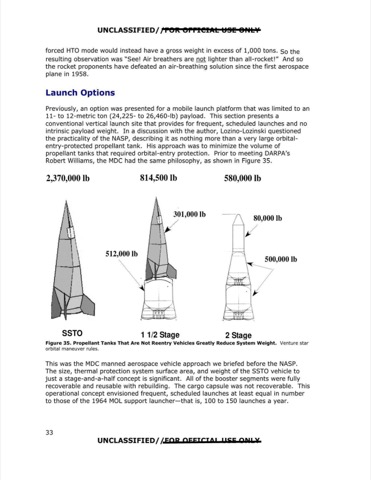
Image from page 40 of DOW-UAP-D124, as released by war.gov
Image from page 40 of the PDF. Open the scan to see the whole page.

Cite this page

U.S. Department of War. "AAWSAP DIRD, Space Access: Where We’ve Been and Where We Could Go, March 2010" (DOW-UAP-D124). PURSUE Release 06, U.S. Department of War, September 18, 2026. https://www.war.gov/medialink/ufo/sept-18/release-06/assets/DOW-UAP-D124_AAWSAP-DIRD-Space%20Access-Where-Weve-Been-and-Where-We-Could-Go-March-8-2010.pdf. Declassified UAP, page 40, https://declassifieduap.org/r/dow-uap-d124-aawsap-dird-space-access-where-weve-been-and-where-we-could-go-march-2010/p/40. Accessed November 28, 2026.

This address shows page 40 on its own; /r/dow-uap-d124-aawsap-dird-space-access-where-weve-been-and-where-we-could-go-march-2010?page=40 opens the same page in the full reader. Both stay. How to cite.