DOW-UAP-D124

AAWSAP DIRD, Space Access: Where We’ve Been and Where We Could Go, March 2010, page 36

One page of a U.S. government record released under PURSUE, shown on its own with its text. The record page has the whole document, its catalog details and the scan.

Page
36 of 56
Agency
Department of War
Released
Release 06, September 18, 2026

Text of page 36

UNCLASSIFIED/ /FOR OFFICIAL USE DALY 300 Propellant Weight 250 Pepellan Weight tons) 50 —A- LACE Constant OWE - LACE Actual OWE Rocket Constant OWE 4004 0 0 5,000 10,000 15,000 20,000 Flight Speed Along Trajectory (ft/sec) 25,000 30,000 Figure 31. LACE Air-Breathing Rocket Reduces Gross Liftoff Weight by 150 Metric Tons and Uses Existing Rocket Engines The LACE or deeply cooled cycle could also be adapted to operate in the FDL- 7/Model 176 if it were a first stage to a two-stage-to-orbit system, 25 as shown in Figure 32 with a retractable, inward- turning inlet.26 In this case, there is Turbo Pump Expander Cycle Rocket another version of the precooled air- Oxygen breathing engine concept, called the KLIN cycle, that was invented by V. V. Hydrogen Balapin.27 Like the LACE and deeply Turbojet cooled systems, the KLIN cycle can significantly reduce the size and weight of a launcher. The KLIN™ Deeply Cooled Inlet Heat Exchanger Turbojet/Rocket Cycle incorporates a heat exchanger upstream of the Figure 32. The FDL-7 Class of Vehicles With An compressor to thermally control the air Anthony DuPont Variable Capture and a Retractable to the compressor so a lower corrected Inlet Tested to Mach 5 Employing an Air-Breathing speed of the compressor can be KLIN Cycle Rocket maintained with the increasing mach number. The cycle also thermally integrates an expander cycle rocket engine, one in which rejected thermal energy is used to drive the turbopumps and accessories. The initial cycle calculations have shown good results for hypersonic vehicle space launcher applications. For mach numbers less than mach 5.5, the turbojet and rocket operate as a single system providing the required total thrust for acceleration. 29 UNCLASSIFIED//FOR OFFICIAL USE ONLY

Machine-read (OCR) from the scan by this archive; it can contain errors. The scan is the record.
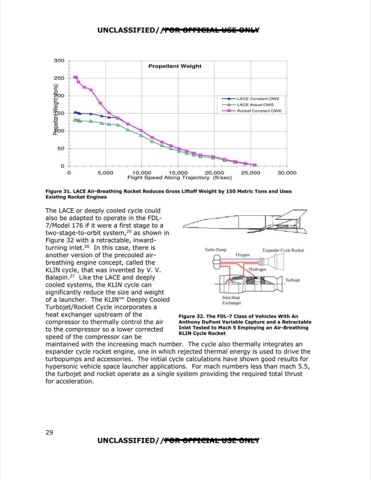
Image from page 36 of DOW-UAP-D124, as released by war.gov
Image from page 36 of the PDF. Open the scan to see the whole page.

Cite this page

U.S. Department of War. "AAWSAP DIRD, Space Access: Where We’ve Been and Where We Could Go, March 2010" (DOW-UAP-D124). PURSUE Release 06, U.S. Department of War, September 18, 2026. https://www.war.gov/medialink/ufo/sept-18/release-06/assets/DOW-UAP-D124_AAWSAP-DIRD-Space%20Access-Where-Weve-Been-and-Where-We-Could-Go-March-8-2010.pdf. Declassified UAP, page 36, https://declassifieduap.org/r/dow-uap-d124-aawsap-dird-space-access-where-weve-been-and-where-we-could-go-march-2010/p/36. Accessed November 28, 2026.

This address shows page 36 on its own; /r/dow-uap-d124-aawsap-dird-space-access-where-weve-been-and-where-we-could-go-march-2010?page=36 opens the same page in the full reader. Both stay. How to cite.