DOW-UAP-D124

AAWSAP DIRD, Space Access: Where We’ve Been and Where We Could Go, March 2010, page 34

One page of a U.S. government record released under PURSUE, shown on its own with its text. The record page has the whole document, its catalog details and the scan.

Page
34 of 56
Agency
Department of War
Released
Release 06, September 18, 2026

Text of page 34

UNCLASSIFIED/ FOR eFFreIAL USE ONLY cases, the low-pressure hydrogen exiting the expansion turbines is entered into the rocket motor at a matching pressure. LACE Deeply Cooled Air Air LOX: - LOX Figure 29. Two Rocket Air-Breathing Rocket Cycles to Mach 5.5. To the left is one employing liquefied air (LACE cycle). To the right is one employing high-pressure air cooled to near saturation. There is always the option of direct ascent by rocket into a trajectory. Whether by turbojet or rocket, a million British Aerospace HOTOL Rolls Royce $45 pounds of thrust is always noisy and smoke filled. We can thank the Russian design bureaus for arriving at a concept that eliminated the noisy, smoky, and hazardous launches by increasing the Interim BaE HOTOL RD 0120 operational flexibility of the British HOTOL concept. Figure 30 shows the development of the all-rocket HOTOL system from the original HOTOL.23 The original air-breathing rocket HOTOL, powered by the Rolls Royce 545 engine as developed by Alan Bond, essentially used all hydrogen fuel (except for space Russian HOTOL RD 0120 operations). The hydrogen required a volume about 5 times greater than a 6:1 LOX/hydrogen propellant for a rocket engine. The classical aerodynamicist's approach was to minimize drag and maximize the L/D ratio. But accelerating to orbital speed requires a low angle of Figure 30. HOTOL Evolution: From Aerodynamic Optimum Configuration to Practical Launcher Configuration. The latter was developed through British Aerospace-Russian cooperation. attack and minimum drag coefficient at zero lift (Cdo), not maximum L/D ratio. The simple problem, recognized by Küchemann, was that the vehicle was too slender and therefore had a large wetted area compared with its reference planform area; hence, zero lift drag and structural weight were too high. Even when the BAE Systems team switched to an all-rocket and compromised the slenderness, this did not significantly reduce the wetted area. The Russian approach was to design a stout vehicle with a much lower ratio of wetter area to reference planform area.24 The trapezoidal cross section of the FDL-7/Model 176 yields a ratio of wetted area to planform area less than the circular cross section of the 27 UNCLASSIFIED//EOR OFFICIAL USE ONLY

Machine-read (OCR) from the scan by this archive; it can contain errors. The scan is the record.
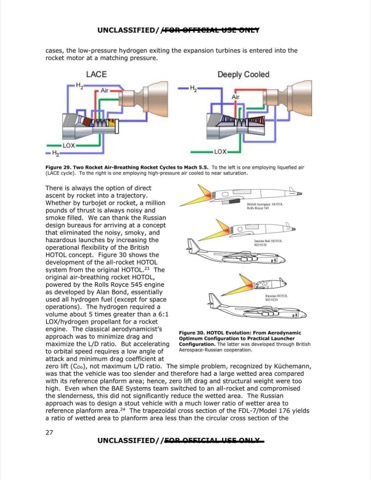
Image from page 34 of DOW-UAP-D124, as released by war.gov
Image from page 34 of the PDF. Open the scan to see the whole page.

Cite this page

U.S. Department of War. "AAWSAP DIRD, Space Access: Where We’ve Been and Where We Could Go, March 2010" (DOW-UAP-D124). PURSUE Release 06, U.S. Department of War, September 18, 2026. https://www.war.gov/medialink/ufo/sept-18/release-06/assets/DOW-UAP-D124_AAWSAP-DIRD-Space%20Access-Where-Weve-Been-and-Where-We-Could-Go-March-8-2010.pdf. Declassified UAP, page 34, https://declassifieduap.org/r/dow-uap-d124-aawsap-dird-space-access-where-weve-been-and-where-we-could-go-march-2010/p/34. Accessed November 28, 2026.

This address shows page 34 on its own; /r/dow-uap-d124-aawsap-dird-space-access-where-weve-been-and-where-we-could-go-march-2010?page=34 opens the same page in the full reader. Both stay. How to cite.