DOW-UAP-D123

AAWSAP DIRD, Positron Aerospace Propulsion, March 2010, page 31

One page of a U.S. government record released under PURSUE, shown on its own with its text. The record page has the whole document, its catalog details and the scan.

Page
31 of 35
Agency
Department of War
Released
Release 06, September 18, 2026

Text of page 31

UNCLASSIFIED/TOR OFFICH AL USE ONLY Lifetime shortening owing to cyclotron radiation of the electron and positron gyrating in the magnetic field are not included in this model. Because this process is proportional to B2, magnetic fields should be small-less than 0.1 Tesla based on our computations of the effect. This, in turn, renders the atom very large, with up to 1-micrometer elongation. If this can be verified in the laboratory, the first of the two conditions laid out in the previous section will be satisfied. E x(a.u.) - 2000 2000 4000 2000 2 (a.u.) 0 Next, it is important to identify a storage medium with the largest possible voids. -2000- Silica aerogel is a promising material that was developed by NASA because of its extremely low density and excellent - 4000} B thermal insulating properties. It is 500 composed of strands of SiOz (silica) grains suspended in a gel that has been dried and expanded by injection of gases to a very-low-density configuration of large voids within an irregular lattice of 509 (a.u.) Figure 21. Computer Simulation of Ps Atoms in a 5-Tesla Magnetic Field and 100 V/cm Electric Field (1 a.u. = 0.052 nm) (courtesy University of Bielefeld, Germany) 74 silica strands (Figure 22). Silica aerogel is available commercially with typically 20-nanometer average voids. Recent research has produced silica aerogel with up to 1-micrometer void sizes. Experiments in Japan and at Positronics Research LLC33 with low-energy positrons in silica aerogel show a high efficiency (~35 percent) for making Ps through the interaction of the positron with silica grains. High radiation exposure from positrons implanted in the material result in it becoming "paramagnetic," permanently at low temperatures, with a high density of "dangling bonds" containing very loosely bound electrons that explains the high efficiency for Ps formation. It therefore serves a dual role as source and storage medium for Ps. What lifetimes might be expected working with this material? 20 nm Figure 22. TEM of Silica Aerogel (courtesy Lawrence Berkeley Laboratory) The Ps decay rate in a porous material is given by:75 1=K/(R-r) + A + 1a (2) 26 UNCLASSIFIED//FOR OFFICIAL USE ONLY

Machine-read (OCR) from the scan by this archive; it can contain errors. The scan is the record.
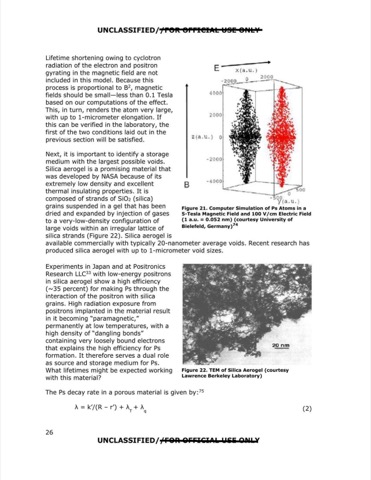
Image from page 31 of DOW-UAP-D123, as released by war.gov
Image from page 31 of the PDF. Open the scan to see the whole page.

Cite this page

U.S. Department of War. "AAWSAP DIRD, Positron Aerospace Propulsion, March 2010" (DOW-UAP-D123). PURSUE Release 06, U.S. Department of War, September 18, 2026. https://www.war.gov/medialink/ufo/sept-18/release-06/assets/DOW-UAP-D123_AAWSAP-DIRD-Positron-Aerospace-Propulsion-March-2-2010.pdf. Declassified UAP, page 31, https://declassifieduap.org/r/dow-uap-d123-aawsap-dird-positron-aerospace-propulsion-march-2010/p/31. Accessed November 28, 2026.

This address shows page 31 on its own; /r/dow-uap-d123-aawsap-dird-positron-aerospace-propulsion-march-2010?page=31 opens the same page in the full reader. Both stay. How to cite.