Text of page 27
UNCLASSIFIED//FOR OFFI
AL USE ONLY
MSS, and the astronauts descend to the Mars surface on the MSL using a high-
thrust variant of the positron rocket engine.
Positron Production
Positrons are currently produced at particle accelerators worldwide for basic and
applications research. For example, the positron-emitting radioisotope Na22 (2.7 year
mean lifetime) is made by bombarding targets with neutrons from a high-energy proton
accelerator in the reaction Alz (n,x)Naz. Capture of these positrons is used to form
beams with keV (slow) to MeV (fast) energies. Handling of large radioactive sources
results in limits of 106 slow positrons/sec.
For intensities up to 101%sec, bombardment of metal targets with electron beams in the
10- to 100-MeV range is used, followed by collection and acceleration (deceleration) of
positrons to form fast or slow beams. In addition, it has recently been shown that slow
positron beams of up to 101/sec can be realized by converting neutrons in reactors to
electron-positron pairs in thin metal foils.
Much higher positron currents are being sought in a variety of proposed solutions.
Illustrated below are a few of the more promising concepts.
First, in 1996, the U.S. Naval Research Laboratory proposed developing an intense
source of fast positrons (1016/sec) utilizing compact electron betatron accelerators.
Second, tabletop femtosecond laser-driven positron sources currently under
development at the National Ignition Facility (Lawrence Livermore National Laboratory),
the Rutherford-Appleton Laboratory (United Kingdom), and the Max Planck Institute
(Munich) look promising, although more must be done to demonstrate efficient
collection of positrons into beams.
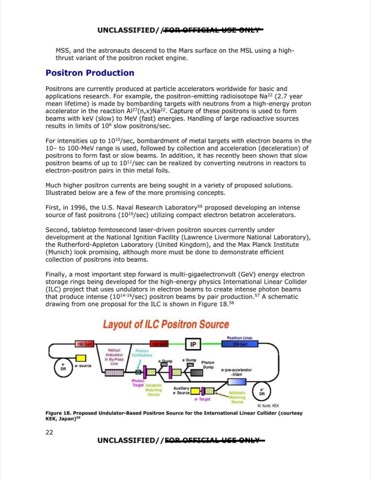
Finally, a most important step forward is multi-gigaelectronvolt (GeV) energy electron
storage rings being developed for the high-energy physics International Linear Collider
(ILC) project that uses undulators in electron beams to create intense photon beams
that produce intense (1014-16/sec) positron beams by pair production.57 A schematic
drawing from one proposal for the ILC is shown in Figure 18.58
Layout of ILC Positron Source
150 GeV
100 CaV
Positron Linac
250 GeV
e- source
Helical
Undulator
In By-Pass
Line
BUBBEA
Photon
Collimators
e Dump
Photon
Dump
DR
e- pre-accelerator
-5GeV
Photon
Target Adiabatic
Matching
Device
Auxiliary
e Source
Adiabatic
•Matching
Davice
DR
М. Кипі, КЕК
Figure 18. Proposed Undulator-Based Positron Source for the International Linear Collider (courtesy
KEK, Japan)59
22
UNCLASSIFIED//EOR OFFICE
AL USE ONLY