DOW-UAP-D123

AAWSAP DIRD, Positron Aerospace Propulsion, March 2010, page 22

One page of a U.S. government record released under PURSUE, shown on its own with its text. The record page has the whole document, its catalog details and the scan.

Page
22 of 35
Agency
Department of War
Released
Release 06, September 18, 2026

Text of page 22

UNCLASSIFIED/ FOR OFFTE AL USE ONLY components. Alternatively, solar collectors or closed-loop nuclear reactors could be employed. To improve ablation efficiency, annihilation gamma rays must be wavelength shifted (WLS) by passing them through a high-Z WLS material. The material of choice, lead, also serves as the shell of the Ps pellet. The pellet vaporizes into high-energy plasma, and the WLS photons propagate to the pressure plate. Silicon carbide ablation material has been adopted from the antiproton catalyzed microfission/fusion concept40, 41 developed at Penn State University by the author and coworkers. Photon energy distributions are shifted through 2 cm of lead to 1-10 keV from 511 keV with 85 percent efficiency. Performance depends primarily on the energy of the WLS photons and the energy per pellet. At 8 keV, Isp is in the range 1,200-3,000 sec. Thrust is 40-145 kN, the latter at a pellet injection rate of 1 hertz. The total quantity of positrons consumed for a one-way trip to Mars over this range of Isp is 15-40 mg with 50 percent of gamma rays striking the plate and a 85 percent WLS efficiency. POSITRON ROCKET SYSTEM COMPARISON A side-by-side comparison of three positron rocket propulsion concepts is presented in Table 5 for a one-way transit to Mars using AV = 3.7 km/sec. Table 5. Comparison of Three Positron Propulsion Concepts for Mars Mission Isp Thrust Limits Solid-Core 650 - 920 sec 72 kN, small class • Wall and nozzle temperature e+ mass Special Notes • 6-9 mg (100% efficiency) Contine engines may be possible • Hot-bleed line possible Gas-Core Sänger Ablation 1000 - 2500 sec 1200 - 3000 sec 130 kN (1000 atm) 40 - 145 kN (1 Hz) • Wall and nozzle • Positron density temperature per pellet • H lonization • < 25 mg (85% • 15 - 40 mg efficiency) (42.5% efficiency) • Pulsed burn • Pulsed burn • Multiple engines • Multiple engines may be possible may be possible • Hot-bleed line • No direct onboard possible power • Engine can be • Engine can be throttled throttled Future work • Efficiency study • Efficiency study • Lower pressure possible? • Further WLS and radiation transport study 17 UNCLASSIFIED/ FOR OFFICIAL USE ONLY

Machine-read (OCR) from the scan by this archive; it can contain errors. The scan is the record.
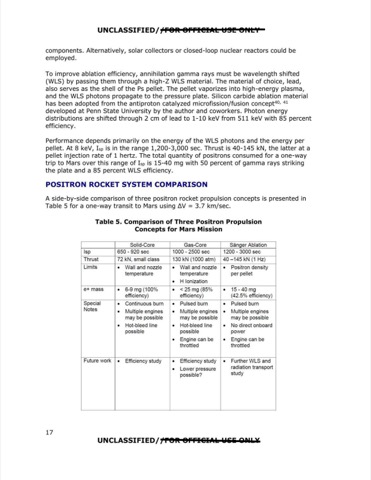
Image from page 22 of DOW-UAP-D123, as released by war.gov
Image from page 22 of the PDF. Open the scan to see the whole page.

Cite this page

U.S. Department of War. "AAWSAP DIRD, Positron Aerospace Propulsion, March 2010" (DOW-UAP-D123). PURSUE Release 06, U.S. Department of War, September 18, 2026. https://www.war.gov/medialink/ufo/sept-18/release-06/assets/DOW-UAP-D123_AAWSAP-DIRD-Positron-Aerospace-Propulsion-March-2-2010.pdf. Declassified UAP, page 22, https://declassifieduap.org/r/dow-uap-d123-aawsap-dird-positron-aerospace-propulsion-march-2010/p/22. Accessed November 28, 2026.

This address shows page 22 on its own; /r/dow-uap-d123-aawsap-dird-positron-aerospace-propulsion-march-2010?page=22 opens the same page in the full reader. Both stay. How to cite.