Text of page 34
UNCLASSIFIED//FOR OFT
AL USE ONLY
where: a and b are dimensions of the sides and 2 is the wavelength.
For conical horns, the gain is given by:
G = 5D2/22
where: D is the diameter and 2 is the wavelength.
Mode conversion is critically important with horn antennas in order to generate field
patterns of use. The fundamental modes, TE10 in rectangular waveguide and TE11 in
circular waveguide, are preferred since they radiate a field pattern with peak field
strength on axis. These are the most common modes used in electronic vulnerability
testing.
Parabolic dish antennas are the most
common type found in conventional
microwave applications, but their use in
narrowband HPM has been limited
because of breakdown problems in
center feed geometries. Variations of
the parabolic dish have, however, been
very successful. The Active Denial
System (ADS) uses a flat parabolic
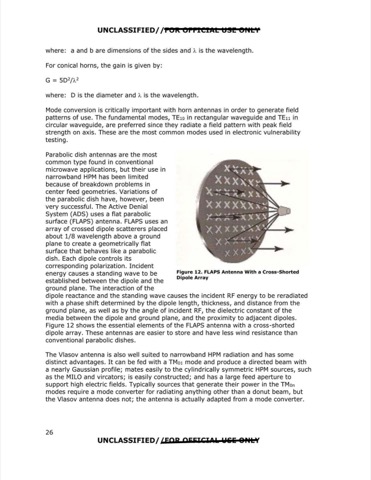
surface (FLAPS) antenna. FLAPS uses an
array of crossed dipole scatterers placed
about 1/8 wavelength above a ground
plane to create a geometrically flat
surface that behaves like a parabolic
dish. Each dipole controls its
corresponding polarization. Incident
energy causes a standing wave to be
Figure 12. FLAPS Antenna With a Cross-Shorted
Dipole Array
established between the dipole and the
ground plane. The interaction of the
dipole reactance and the standing wave causes the incident RF energy to be reradiated
with a phase shift determined by the dipole length, thickness, and distance from the
ground plane, as well as by the angle of incident RF, the dielectric constant of the
media between the dipole and ground plane, and the proximity to adjacent dipoles.
Figure 12 shows the essential elements of the FLAPS antenna with a cross-shorted
dipole array. These antennas are easier to store and have less wind resistance than
conventional parabolic dishes.
The Vlasov antenna is also well suited to narrowband HPM radiation and has some
distinct advantages. It can be fed with a TMo mode and produce a directed beam with
a nearly Gaussian profile; mates easily to the cylindrically symmetric HPM sources, such
as the MILO and vircators; is easily constructed; and has a large feed aperture to
support high electric fields. Typically sources that generate their power in the TMon
modes require a mode converter for radiating anything other than a donut beam, but
verter aly aires anything ote
the Vlasov antenna does not; the antenna is actually adapted from a mode converter.
26
UNCLASSIFIED/ LEOR DEFICIAL USE ONLY