Text of page 21
UNCLASSIFIED// FOR OFF
AL USE ONLY
rise time is the time required to heat the gas channel to full conductivity, and the
inductive rise time is the delay caused by the addition of the switch into the circuit.
There are two contributions to the inductive rise time, with Le being the spark channel
inductance and Ln the housing inductance. A shorter switch gap reduces the inductive
time by lowering the channel inductance but also increases the electric field in the gap,
reducing the resistive time and resulting in a faster rise time. Even though the switch
electrodes are usually designed for minimal cross-sectional area at a given current, the
very short electrode separation required can still result in high interelectrode switch
capacitance. As mentioned earlier, it is also preferable to charge the switch very quickly
to achieve an overvolted switching condition, and, therefore, very fast switches always
have some level of pre-pulse. Because the PRR is also of great importance, hydrogen
has been chosen most often for high-speed gas switching in UWB HPM sources.
Switches of this type have achieved rise times of just over 100 picoseconds (ps) and
PRRs of 1,500 pulses per second.
Another type of gas switch meriting mention for its utility and indispensability in the
HPM pulsed-power driver circuits is the hydrogen thyratron. The thyratron is a partial
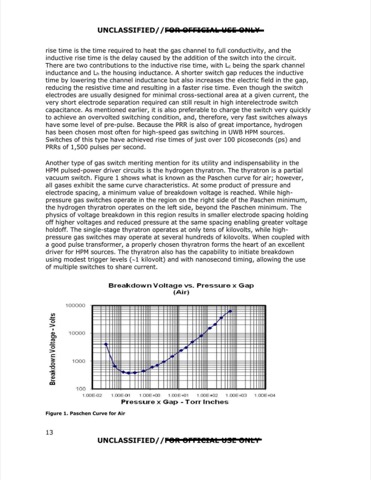
vacuum switch. Figure 1 shows what is known as the Paschen curve for air; however,
all gases exhibit the same curve characteristics. At some product of pressure and
electrode spacing, a minimum value of breakdown voltage is reached. While high-
pressure gas switches operate in the region on the right side of the Paschen minimum,
the hydrogen thyratron operates on the left side, beyond the Paschen minimum. The
physics of voltage breakdown in this region results in smaller electrode spacing holding
off higher voltages and reduced pressure at the same spacing enabling greater voltage
holdoff. The single-stage thyratron operates at only tens of kilovolts, while high-
pressure gas switches may operate at several hundreds of kilovolts. When coupled with
a good pulse transformer, a properly chosen thyratron forms the heart of an excellent
driver for HPM sources. The thyratron also has the capability to initiate breakdown
using modest trigger levels (~1 kilovolt) and with nanosecond timing, allowing the use
of multiple switches to share current.
Breakdown Voltage vs. Pressure x Gap
(Air)
100000
Breakdown Voltage - Volts
10000
1000
100
1.00E-02
Figure 1. Paschen Curve for Air
1.00E-01 1.00+00 1.00E+01 1.00+02 1.00+03
Pressure x Gap - Torr Inches
1.00E +04
13
UNCLASSIFIED/ / FOR OF
AL USE ONLY