Text of page 19
UNCLASSIFIED/TOR OFFICIAL USE ONLY
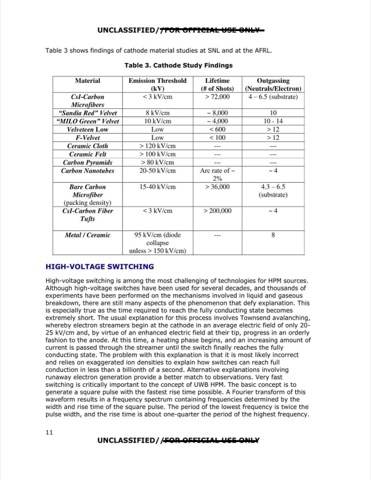
Table 3 shows findings of cathode material studies at SNL and at the AFRL.
Table 3. Cathode Study Findings
Material
Emission Threshold
(kV)
< 3 kV/cm
Lifetime
(# of Shots)
> 72,000
Outgassing
(Neutrals/Electron)
4 - 6.5 (substrate)
Csl-Carbon
Microfibers
"Sandia Red" Velvet
"MILO Green" Velvet
Velveteen Low
F- Velvet
Ceramic Cloth
Ceramic Felt
Carbon Pyramids
Carbon Nanotubes
8 kV/cm
10 kV/cm
Low
Low
> 120 kV/cm
> 100 kV/cm
> 80 kV/cm
20-50 kV/cm
- 8,000
~ 4,000
< 600
< 100
Bare Carbon
Microfiber
(packing density)
Csl-Carbon Fiber
Tufts
15-40 kV/cm
---
---
Arc rate of ~
2%
> 36,000
10
10 - 14
> 12
> 12
--
---
--
- 4
4.3 - 6.5
(substrate)
< 3 kV/cm
> 200,000
- 4
Metal / Ceramic
95 kV/cm (diode
collapse
unless > 150 kV/cm)
---
8
HIGH-VOLTAGE SWITCHING
High-voltage switching is among the most challenging of technologies for HPM sources.
Although high-voltage switches have been used for several decades, and thousands of
experiments have been performed on the mechanisms involved in liquid and gaseous
breakdown, there are still many aspects of the phenomenon that defy explanation. This
is especially true as the time required to reach the fully conducting state becomes
extremely short. The usual explanation for this process involves Townsend avalanching,
whereby electron streamers begin at the cathode in an average electric field of only 20-
25 kV/cm and, by virtue of an enhanced electric field at their tip, progress in an orderly
fashion to the anode. At this time, a heating phase begins, and an increasing amount of
current is passed through the streamer until the switch finally reaches the fully
conducting state. The problem with this explanation is that it is most likely incorrect
and relies on exaggerated ion densities to explain how switches can reach full
conduction in less than a billionth of a second. Alternative explanations involving
runaway electron generation provide a better match to observations. Very fast
switching is critically important to the concept of UWB HPM. The basic concept is to
generate a square pulse with the fastest rise time possible. A Fourier transform of this
waveform results in a frequency spectrum containing frequencies determined by the
width and rise time of the square pulse. The period of the lowest frequency is twice the
pulse width, and the rise time is about one-quarter the period of the highest frequency.
11
UNCLASSIFIED/ /FOR OFF
AL USE ONLY