Text of page 13
UNCLASSIFIED//FOR
AL usE ontY
thus, implies heightened safety concerns. Even low-volume vessels can contain
hundreds of joules of energy in the compressed gas, and a housing failure can hurl
fragments at deadly velocities. Highly compressed gases are used only in cases where
some prized benefit is worth the increased cost and design trials to be exacted. One
example of this is extremely fast switching where the electrode spacing is proportional
to the added inductance during conduction-the smaller electrode spacing requires
higher gas pressure for insulation. Almost every common gas has been used as
insulation, and many have attributes making them desirable for certain applications.
Sulfur hexafluoride, nitrogen, air, argon, helium, oxygen, and hydrogen are commonly
used. Of these, only sulfur hexafluoride is an electronegative gas, meaning it has the
ability to remove electrons from the volume through the formation of negative ions and
thereby increase the dielectric strength. Electrical discharges in sulfur hexafluoride
result in foul-smelling sulfur compounds that also deposit on the switch housing and
electrodes and require frequent cleaning. These discharge compounds also tend to be
highly corrosive, especially in the presence of water. Other gases with electronegative
species, typically other halogens such as chlorine, also make good insulators. These
gases are usually much denser than air, and breakdown voltage is roughly proportional
to density, thus higher voltages can be supported even at low pressures. The
halogenated hydrocarbon refrigerants, such as CCI4, CClF2, CCIF, and C2C|2F4, are also
popular for insulation. The breakdown of air has been thoroughly researched, and in
fact the breakdown voltage of a calibrated gap can be used to determine the magnitude
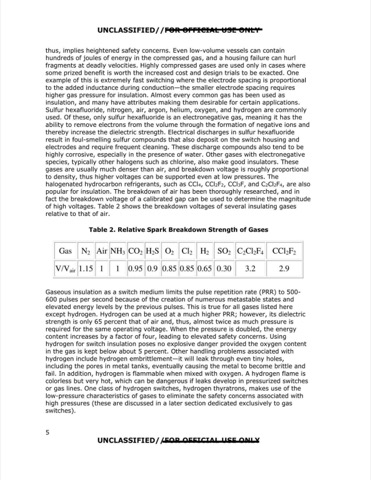
of high voltages. Table 2 shows the breakdown voltages of several insulating gases
relative to that of air.
Table 2. Relative Spark Breakdown Strength of Gases
Gas N2 Air NH3 COz H2S 02
Chz
H2
SO2
C2CLF4
CC12F2
V/Nair
1.15
1 0.95 0.9 0.85
0.85
0.65
0.30
3.2
2.9
Gaseous insulation as a switch medium limits the pulse repetition rate (PRR) to 500-
600 pulses per second because of the creation of numerous metastable states and
elevated energy levels by the previous pulses. This is true for all gases listed here
except hydrogen. Hydrogen can be used at a much higher PRR; however, its dielectric
strength is only 65 percent that of air and, thus, almost twice as much pressure is
required for the same operating voltage. When the pressure is doubled, the energy
content increases by a factor of four, leading to elevated safety concerns. Using
hydrogen for switch insulation poses no explosive danger provided the oxygen content
in the gas is kept below about 5 percent. Other handling problems associated with
hydrogen include hydrogen embrittlement—it will leak through even tiny holes,
including the pores in metal tanks, eventually causing the metal to become brittle and
fail. In addition, hydrogen is flammable when mixed with oxygen. A hydrogen flame is
colorless but very hot, which can be dangerous if leaks develop in pressurized switches
or gas lines. One class of hydrogen switches, hydrogen thyratrons, makes use of the
low-pressure characteristics of gases to eliminate the safety concerns associated with
high pressures (these are discussed in a later section dedicated exclusively to gas
switches).
5
UNCLASSIFIED/ /EOR OFFICIAL LISE ONLY