Text of page 11
UNCLASSIFIED//FOR OFFICIAL USE ONLY
section on laminated insulation). Many plastics come in a wide variety of shapes, forms,
and grades, including bulk volumes, a variety of sheet thicknesses, and various rod
diameters. The subject of using plastics as insulation fills volumes in reference books
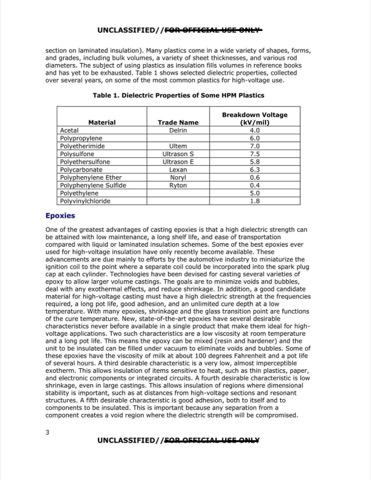
and has yet to be exhausted. Table 1 shows selected dielectric properties, collected
over several years, on some of the most common plastics for high-voltage use.
Table 1. Dielectric Properties of Some HPM Plastics
Material
Trade Name
Delrin
Acetal
Polypropylene
Polyetherimide
Polysulfone
Polyethersulfone
Polycarbonate
Polyphenylene Ether
Polyphenylene Sulfide
Polyethylene
Polyvinylchloride
Ultem
Ultrason S
Ultrason E
Lexan
Nory!
Ryton
Breakdown Voltage
(kV/mil)
4.0
6.0
7.0
7.5
5.8
6.3
0.6
0.4
5.0
1.8
Epoxies
One of the greatest advantages of casting epoxies is that a high dielectric strength can
be attained with low maintenance, a long shelf life, and ease of transportation
compared with liquid or laminated insulation schemes. Some of the best epoxies ever
used for high-voltage insulation have only recently become available. These
advancements are due mainly to efforts by the automotive industry to miniaturize the
ignition coil to the point where a separate coil could be incorporated into the spark plug
cap at each cylinder. Technologies have been devised for casting several varieties of
epoxy to allow larger volume castings. The goals are to minimize voids and bubbles,
deal with any exothermal effects, and reduce shrinkage. In addition, a good candidate
material for high-voltage casting must have a high dielectric strength at the frequencies
required, a long pot life, good adhesion, and an unlimited cure depth at a low
temperature. With many epoxies, shrinkage and the glass transition point are functions
of the cure temperature. New, state-of-the-art epoxies have several desirable
characteristics never before available in a single product that make them ideal for high-
voltage applications. Two such characteristics are a low viscosity at room temperature
and a long pot life. This means the epoxy can be mixed (resin and hardener) and the
unit to be insulated can be filled under vacuum to eliminate voids and bubbles. Some of
these epoxies have the viscosity of milk at about 100 degrees Fahrenheit and a pot life
of several hours. A third desirable characteristic is a very low, almost imperceptible
exotherm. This allows insulation of items sensitive to heat, such as thin plastics, paper,
and electronic components or integrated circuits. A fourth desirable characteristic is low
shrinkage, even in large castings. This allows insulation of regions where dimensional
stability is important, such as at distances from high-voltage sections and resonant
structures. A fifth desirable characteristic is good adhesion, both to itself and to
components to be insulated. This is important because any separation from a
component creates a void region where the dielectric strength will be compromised.
3
UNCLASSIFIED//FOR
AL USE OALY