DOW-UAP-D120

AAWSAP DIRD, Materials for Advanced Aerospace Platforms, January 2010, page 7

One page of a U.S. government record released under PURSUE, shown on its own with its text. The record page has the whole document, its catalog details and the scan.

Page
7 of 27
Agency
Department of War
Released
Release 06, September 18, 2026

Text of page 7

UNCLASSIFIED//TOR U AL USE ONLY The newer Al alloys also can be specially processed to render them superplastically formable. This capability opens a realm of possibilities to replace structures that, in the absence of this capability, are machined from thick plate. Very large structures are produced in sections that must be joined. Conventional fusion welding techniques do not work for high-strength Al alloys such as 7075, 7050, 2024, or 2050 because either the welds lead to cracks or the welds made under conditions that avoid cracking have greatly reduced tensile properties. Because these alloys are not amenable to welding, heavier, fatigue-prone mechanically fastened joints must be used. Recently, scientists developed a joining process that permits joining of Al alloys such as 7050. This process, called friction stir welding (FSW), allows joint designs in a variety of configurations that were not considered possible when fusion welding was the only alternative. In FSW, a rotating steel tool is inserted into the seam between the two Al alloy pieces to be joined. As the rotating tool is driven forward, the friction between the tool and the work piece generates enough heat to soften the Al alloy without melting it. A schematic of this process is shown in Figure 1. tool rotation Tool velocity advancing side retreating side Figure 1. Schematic Diagram of Friction Stir Welding The combined action of the rotation and the traversing of the tool essentially kneads the two pieces together, leaving a mechanically sound joint. Although the weld properties may be somewhat inferior to those of the base metal, they are good enough that a relatively small increase in thickness at the joint position can compensate. Although substantial development of the FSW process is ongoing, FSW already has been put into practice. For example, the current external propellant tank on the space shuttle is made from an Al-Li alloy fabricated through FSW. The weight advantage of using welded as opposed to bolted joints in a large structure such as a launch vehicle is considerable. With earlier high-strength alloys such as 7075, concerns about fracture toughness in conjunction with monolithic structures would have caused a welded 2 UNCLASSIFIED//FOR OFFICIAL USE ONLY

Machine-read (OCR) from the scan by this archive; it can contain errors. The scan is the record.
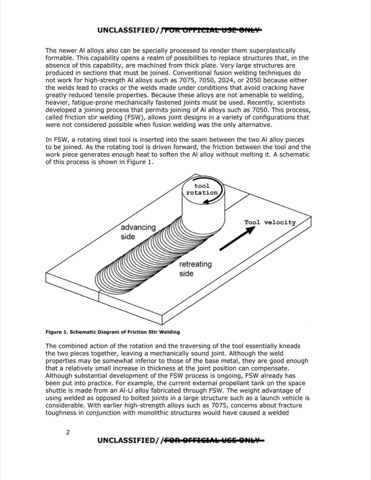
Image from page 7 of DOW-UAP-D120, as released by war.gov
Image from page 7 of the PDF. Open the scan to see the whole page.

Cite this page

U.S. Department of War. "AAWSAP DIRD, Materials for Advanced Aerospace Platforms, January 2010" (DOW-UAP-D120). PURSUE Release 06, U.S. Department of War, September 18, 2026. https://www.war.gov/medialink/ufo/sept-18/release-06/assets/DOW-UAP-D120_AAWSAP-DIRD-Materials-for-Advanced-Aerospace-Platforms-January-12-2010.pdf. Declassified UAP, page 7, https://declassifieduap.org/r/dow-uap-d120-aawsap-dird-materials-for-advanced-aerospace-platforms-january-2010/p/7. Accessed November 28, 2026.

This address shows page 7 on its own; /r/dow-uap-d120-aawsap-dird-materials-for-advanced-aerospace-platforms-january-2010?page=7 opens the same page in the full reader. Both stay. How to cite.