Text of page 19
UNCLASSIFIED//FOR OFFrEIAL USE ONL
• Once a case is present, can the structure be repaired (for example, by fusion or
friction stir welding)?
The Air Force Materials and Manufacturing Directorate is starting a new project intended
to address these questions. The motivation for this program is hypersonic flight
vehicles. The results from this U.S. Air Force program should prove highly useful to the
design of future reusable SSO vehicles.
Earlier uses of Ti alloys at high temperatures included the skin and much of the load-
bearing structure of the SR-71 Blackbird. This airplane flew successfully at peak speeds
in excess of mach 3.2 for 34 years (1964-1998). While the maximum skin temperatures
are not readily available, they were in excess of 300 °Celsius. There were no known
issues involving a case during the SR-71's service. Notably, the primary alloy used for
the SR-71 was one of the original B-Ti alloys, B-120 VCA, the composition of which is
Ti-13V-11Cr-3Al. The primary reason for choosing this alloy was that it is much easier
than any of the a+ß Ti alloys are to roll into sheet gauges. Today there are newer B-Ti
sheet alloys featuring a better balance of properties that could be used in the same way
as B-120 VCA. The most common of these is Ti-15V-3Cr-3Sn-3Al. However, the
successful use of B-120 VCA raises the question of whether B-Ti alloys are more
resistant than a+ß alloys such as Ti-6-4 are to a case formation.
The attraction to using Ti alloys, in addition to their structural efficiency, is the
extensive industrial base for making the material in a variety of product forms and the
extensive knowledge base resulting from the many successful applications of Ti alloys in
high-performance products. For example, the ability to superplastically form Ti alloys
such as Ti-6-4 creates the opportunity for design of a structure that functions both as
load bearing and as thermal protection.
Ti Matrix Composites
As Table 1 showed, Ti alloys are not especially attractive for their specific stiffness. One
way to overcome this limitation is to reinforce a Ti alloy matrix with SiC fibers. In this
case, the fibers are "long" fibers-they have sufficient length for the matrix to transfer
the maximum possible fraction of the external load to the fiber. The fibers are
essentially monofilaments and must be carefully placed so adjacent fibers do not touch
one another. Areas of contact between fibers essentially are incipient cracks that
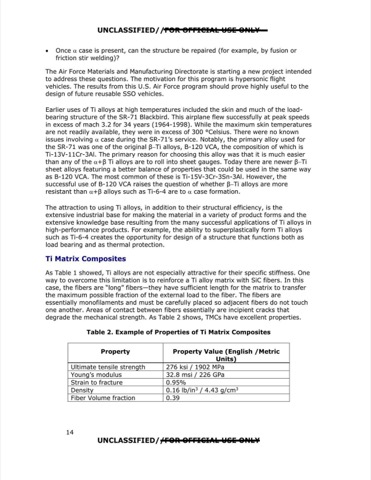
degrade the mechanical strength. As Table 2 shows, MCs have excellent properties.
Table 2. Example of Properties of Ti Matrix Composites
Property
Ultimate tensile strength
Young's modulus
Strain to fracture
Density
Fiber Volume fraction
Property Value (English / Metric
Units)
276 ksi / 1902 MPa
32.8 msi / 226 GPa
0.95%
0.16 lb/in3 / 4.43 g/cm3
0.39
14
UNCLASSIFIED//FOR OFFICIAL USE ONLY