Text of page 15
UNCLASSIFIED// FOR OFFICIAL USE ONLY
considered in light of the thermal stresses that were certain to develop in a large
structure placed in the fluidized bed.
Reusable Single-Stage-to-Orbit Vehicles
A reusable single-stage-to-orbit (SSO) vehicle will require metallic materials for the TPS
and for much of the other hot structure. This will be challenging from the standpoint of
an empty vehicle weight. With the exception of military applications, which are outside
the scope of this document, empty vehicle weight is a critical metric because every
additional pound of empty weight reduces the payload by the same amount (assuming
a fixed propulsion capability). As mentioned earlier, the key to a lightweight vehicle is
the use of design methods that integrate the TPS and the load-bearing structure to
minimize structural redundancy and single-function structure (for example, a TPS that
is not load bearing). Achieving this goal will require new design paradigms that
incorporate true synthesis of new structural concepts. In reality, such designs can be
completed only if they are based on a detailed set of mission requirements, including
the number of missions and expectations for turnaround time between missions.
Furthermore, operational parameters such as the value of inserting a pound of payload
into orbit are needed to bound the cost of the initial vehicle and the maintenance cost
per mission (translated into cost per pound of payload). Absent such specific data, the
following discusses possibilities for materials systems that can enable a reusable SSO
vehicle. It is perhaps more efficient to discuss these materials according to their
principal capability and the anticipated temperature regime in which they can be used
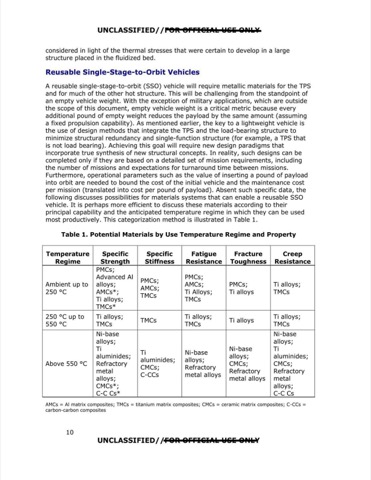
most productively. This categorization method is illustrated in Table 1.
Table 1. Potential Materials by Use Temperature Regime and Property
Temperature
Regime
Ambient up to
250 °C
250 °C up to
550 °C
Above 550 °C
Specific
Strength
PMCs;
Advanced Al
alloys;
AMCs*;
Ti alloys;
TMCS*
Ti alloys;
TMCS
Ni-base
alloys;
Ti
aluminides;
Refractory
metal
alloys;
Specific
Stiffness
Fatigue
Resistance
Fracture
Toughness
Creep
Resistance
AMCS;
TMCS
PMCs;
AMCs;
Ti Alloys;
TMCS
PMCs;
Ti alloys
Ti alloys;
TMCS
TMCS
Ti alloys;
TMCS
Ti
aluminides;
Ni-base
alloys;
Refractory
metal alloys
Ti alloys
Ti alloys;
TMCS
Ni-base
alloys;
Ni-base
Ti
alloys;
aluminides;
CMCS;
CMCs;
Refractory
Refractory
metal alloys
metal
alloys;
C-C Cs
AMCS = Al matrix composites; TMCs = titanium matrix composites; CMCs = ceramic matrix composites; C-CCs =
carbon-carbon composites
10
UNCLASSIFIED//FOR OFFICIAL USE ONLY