Text of page 8
UNCLASSIFIED//FOR OFFICIAL USE ONLY
Biomaterials for Biosensors
Implantable biosensors for the human body place some of the greatest functional
demands on biomaterials. Biosensors monitor the physiologic state of tissues for
medical therapeutics or for assessing human performance. Sensors for glucose, oxygen,
blood pH, adrenal hormones, nervous activity, heart performance, and blood pressure
monitors are all of interest.
Blood biochemistry sensors are the most difficult sensors to keep functioning over time
primarily because the sensor interface materials provoke low-level foreign-body
reactions in tissues. These types of responses are not specifically important to
implantable devices that have structural rather than sensing functions, such as heart
valves, but they can completely render a biosensor for blood glucose, for example,
useless after a few days.
Chemically sensitive biosensor interfaces to tissue and body environments employ
membranes in an effort to protect the biosensor active-sensing surface from possible
body reactions. The membrane allows small molecules of interest to pass through its
pores while excluding larger proteins, blood-formed elements, and cells like
macrophages that would engulf the sensor.
The membrane's biomaterial composition, pore size, and long-term physical integrity
are critical components in the functioning of the sensor. If the biomaterial chosen
retards the adhesion of proteins and does not provoke a biological response, then this
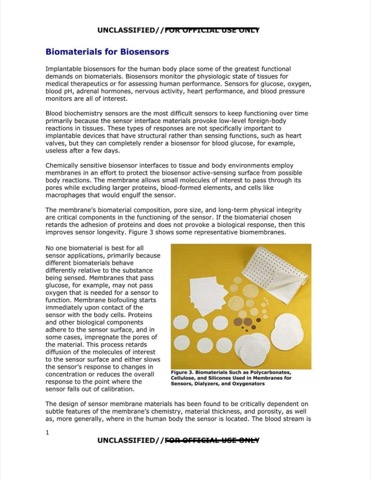
improves sensor longevity. Figure 3 shows some representative biomembranes.
No one biomaterial is best for all
sensor applications, primarily because
different biomaterials behave
differently relative to the substance
being sensed. Membranes that pass
glucose, for example, may not pass
oxygen that is needed for a sensor to
function. Membrane biofouling starts
immediately upon contact of the
sensor with the body cells. Proteins
and other biological components
adhere to the sensor surface, and in
some cases, impregnate the pores of
the material. This process retards
diffusion of the molecules of interest
to the sensor surface and either slows
the sensor's response to changes in
concentration or reduces the overall
response to the point where the
sensor falls out of calibration.
Figure 3. Biomaterials Such as Polycarbonates,
Cellulose, and Silicones Used in Membranes for
Sensors, Dialyzers, and Oxygenators
The design of sensor membrane materials has been found to be critically dependent on
subtle features of the membrane's chemistry, material thickness, and porosity, as well
as, more generally, where in the human body the sensor is located. The blood stream is
1
UNCLASSIFIED// FO
USE ONLY