DOW-UAP-D119

AAWSAP DIRD, Biomaterials, January 2010, page 5

One page of a U.S. government record released under PURSUE, shown on its own with its text. The record page has the whole document, its catalog details and the scan.

Page
5 of 32
Agency
Department of War
Released
Release 06, September 18, 2026

Text of page 5

UNCLASSIFIED//FOR OFFICIAL USE ONLY Biomaterials Introduction Biomaterials are metals, ceramics, polymers, glasses, carbons, and composite materials intended to interface with biological systems. They are often used to treat, augment, or replace bodily tissues, organs, or functions. Such materials are used in various forms, including molded or machined parts, coatings, fibers, films, foams, and fabrics. Biomaterials are usually nonliving, but recent definitions also include living skin and tissues produced in culture. A biocompatible material is different from a biological material produced by a biological system, such as bone. Artificial hips, vascular stents, artificial pacemakers, and catheters are all made of biocompatible materials that typically have a synthetic origin. An extraordinarily wide range of medical devices are made from biomaterials. Figure 1 shows some representative examples of medical devices that use biomaterials. Finger joint Breast implant SHELL? FILLER LICONE GEL Heart valve VN silicone rubber Hip joint silicones Artificial heart polyurethane, metal polyester, stainless steel Intraocular lens (IOL) titanium poly(methyl methacrylate) Figure 1. Biomaterial Applications in Medical Devices Encompassing elements of medicine, biology, chemistry, and materials science, biomaterials science has experienced steady and strong growth over its approximately half-century history. Although biomaterials are used primarily for medical applications, they are also used to grow cells in culture, to assay for blood proteins in the clinical vi UNCLASSIFIED// FOR OFFICIAL USE ONLY

Machine-read (OCR) from the scan by this archive; it can contain errors. The scan is the record.
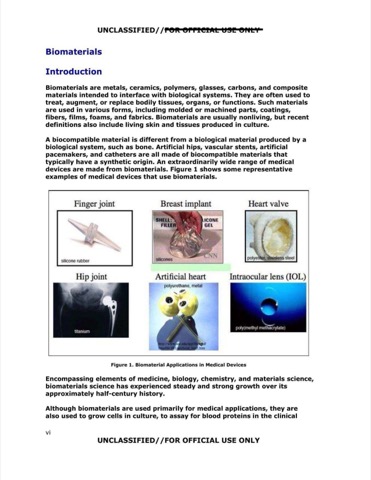
Image from page 5 of DOW-UAP-D119, as released by war.gov
Image from page 5 of the PDF. Open the scan to see the whole page.

Cite this page

U.S. Department of War. "AAWSAP DIRD, Biomaterials, January 2010" (DOW-UAP-D119). PURSUE Release 06, U.S. Department of War, September 18, 2026. https://www.war.gov/medialink/ufo/sept-18/release-06/assets/DOW-UAP-D119_AAWSAP-DIRD-Biomaterials-January-7-2010.pdf. Declassified UAP, page 5, https://declassifieduap.org/r/dow-uap-d119-aawsap-dird-biomaterials-january-2010/p/5. Accessed November 28, 2026.

This address shows page 5 on its own; /r/dow-uap-d119-aawsap-dird-biomaterials-january-2010?page=5 opens the same page in the full reader. Both stay. How to cite.