Text of page 14
UNCLASSIFIED/ /FOR OFFre
AL USE ONLY
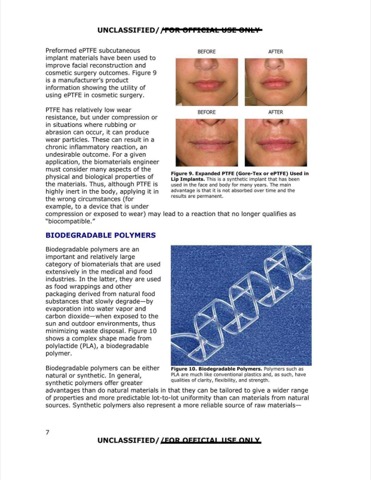
Preformed ePTFE subcutaneous
implant materials have been used to
improve facial reconstruction and
cosmetic surgery outcomes. Figure 9
is a manufacturer's product
information showing the utility of
using ePTFE in cosmetic surgery.
BEFORE
AFTER
PTFE has relatively low wear
BEFORE
AFTER
resistance, but under compression or
in situations where rubbing or
abrasion can occur, it can produce
wear particles. These can result in a
chronic inflammatory reaction, an
undesirable outcome. For a given
application, the biomaterials engineer
must consider many aspects of the
physical and biological properties of
the materials. Thus, although PTFE is
highly inert in the body, applying it in
Figure 9. Expanded PTFE (Gore-Tex or ePTFE) Used in
Lip Implants. This is a synthetic implant that has been
used in the face and body for many years. The main
advantage is that it is not absorbed over time and the
results are permanent.
the wrong circumstances (for
example, to a device that is under
compression or exposed to wear) may lead to a reaction that no longer qualifies as
"biocompatible."
BIODEGRADABLE POLYMERS
Biodegradable polymers are an
important and relatively large
category of biomaterials that are used
extensively in the medical and food
industries. In the latter, they are used
as food wrappings and other
packaging derived from natural food
substances that slowly degrade-by
evaporation into water vapor and
carbon dioxide-when exposed to the
sun and outdoor environments, thus
minimizing waste disposal. Figure 10
shows a complex shape made from
polylactide (PLA), a biodegradable
polymer.
Biodegradable polymers can be either
Figure 10. Biodegradable Polymers. Polymers such as
natural or synthetic. In general,
PLA are much like conventional plastics and, as such, have
synthetic polymers offer greater
qualities of clarity, flexibility, and strength.
advantages than do natural materials in that they can be tailored to give a wider range
of properties and more predictable lot-to-lot uniformity than can materials from natural
sources. Synthetic polymers also represent a more reliable source of raw materials—
7
UNCLASSIFIED/ LEOR DEFICIAL USE ONLY