Text of page 6
UNCLASSIFIED//FOR OFFICIAL USE UNLI
Conduction Band
INCREASING ENERGY
Conduction Band
Band Gap
Valence Band
ele)
Metal
Semiconductor
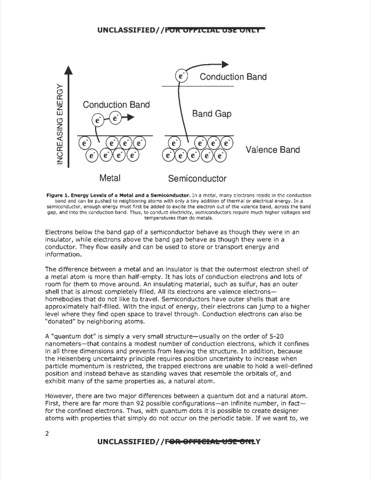
Figure 1. Energy Levels of a Metal and a Semiconductor. In a metal, many electrons reside in the conduction
band and can be pushed to neighboring atoms with only a tiny addition of thermal or electrical energy. In a
semiconductor, enough energy must first be added to excite the electron out of the valence band, across the band
gap, and into the conduction band. Thus, to conduct electricity, semiconductors require much higher voltages and
temperatures than do metals.
Electrons below the band gap of a semiconductor behave as though they were in an
insulator, while electrons above the band gap behave as though they were in a
conductor. They flow easily and can be used to store or transport energy and
information.
The difference between a metal and an insulator is that the outermost electron shell of
a metal atom is more than half-empty. It has lots of conduction electrons and lots of
room for them to move around. An insulating material, such as sulfur, has an outer
shell that is almost completely filled. All its electrons are valence electrons-
homebodies that do not like to travel. Semiconductors have outer shells that are
approximately half-filled. With the input of energy, their electrons can jump to a higher
level where they find open space to travel through. Conduction electrons can also be
"donated" by neighboring atoms.
A "quantum dot" is simply a very small structure-usually on the order of 5-20
nanometers--that contains a modest number of conduction electrons, which it confines
in all three dimensions and prevents from leaving the structure. In addition, because
the Heisenberg uncertainty principle requires position uncertainty to increase when
particle momentum is restricted, the trapped electrons are unable to hold a well-defined
position and instead behave as standing waves that resemble the orbitals of, and
exhibit many of the same properties as, a natural atom.
However, there are two major differences between a quantum dot and a natural atom.
First, there are far more than 92 possible configurations- an infinite number, in fact-
for the confined electrons. Thus, with quantum dots it is possible to create designer
atoms with properties that simply do not occur on the periodic table. If we want to, we
2
UNCLASSIFIED// FOR eFFIeTAL USE ONLY