DOW-UAP-D118

AAWSAP DIRD, Aerospace Applications of Programmable Matter, December 2009, page 10

One page of a U.S. government record released under PURSUE, shown on its own with its text. The record page has the whole document, its catalog details and the scan.

Page
10 of 20
Agency
Department of War
Released
Release 06, September 18, 2026

Text of page 10

UNCLASSIFIED// Fe AL USE ONLY Conductors P-Layer N-Layer -Memory Power & Control Signals Figure 4. Wellstone Fiber. A notional "Wellstone" fiber uses careful arrangements of conductors, semiconductors, and insulators to produce a long, flexible cylinder whose surface is studded with artificial atoms. When woven together, these fibers create a bulk material whose properties are programmable via external signals. In the future, advanced supercomputers may be able to monitor the objects around us—our desks, our countertops, our walls and windows and chairs-and modify their properties to suit the needs of the moment. Transparent or opaque? Reflective or absorptive? Conductive or insulating? Magnetic? Flexible? Luminous? In theory, a block of true Programmable Matter should be able to select any point on any of these axes at any time. Other effects may be desired as well, including magnetoresistivity, photo-/thermo-/piezoelectric effects, superconductivity, and the ability to perform computations (a truly "smart" smart material). Unfortunately, many of these traits are strongly correlated, so that, for example, a material that managed to be both electrically conductive and thermally insulative probably could not be made transparent as well. A computer is unlikely to double as an air conditioner. Still, the possible combinations-the number of things we could actually do-would be much larger than the (already vast) range of natural material combinations. Although the smart matter of 2050 will probably be operated electrically, electrical operation presents a number of challenges today. First, the required nanostructures are very small and intricate, with manufacturing tolerances that push or exceed the limits of current technology. Second, the control wires, electrodes, and other conductors in such devices mean they will likely be vulnerable to electromagnetic interference. Like a pocket calculator in a microwave oven, programmable materials face a harsh electromagnetic environment and will need to be shielded and safeguarded against spurious behavior. In addition, there is the threat of hackers. As our society turns over the control of more and more infrastructure to computers, we add not only new strengths but also new vulnerabilities. We must be extremely cautious about handing malicious hackers the keys to matter itself! 6 UNCLASSIFIED/ FOR OFFICI AL USE ONLY

Machine-read (OCR) from the scan by this archive; it can contain errors. The scan is the record.
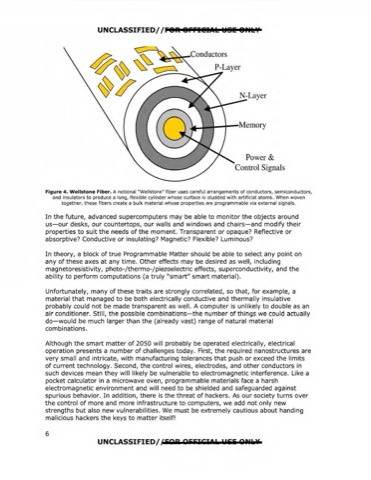
Image from page 10 of DOW-UAP-D118, as released by war.gov
Image from page 10 of the PDF. Open the scan to see the whole page.

Cite this page

U.S. Department of War. "AAWSAP DIRD, Aerospace Applications of Programmable Matter, December 2009" (DOW-UAP-D118). PURSUE Release 06, U.S. Department of War, September 18, 2026. https://www.war.gov/medialink/ufo/sept-18/release-06/assets/DOW-UAP-D118_AAWSAP-DIRD-Aerospace-Applications-of-Programmable-Matter-December-14-2009.pdf. Declassified UAP, page 10, https://declassifieduap.org/r/dow-uap-d118-aawsap-dird-aerospace-applications-of-programmable-matter-december-2009/p/10. Accessed November 28, 2026.

This address shows page 10 on its own; /r/dow-uap-d118-aawsap-dird-aerospace-applications-of-programmable-matter-december-2009?page=10 opens the same page in the full reader. Both stay. How to cite.