DOW-UAP-D117

AAWSAP DIRD, Metallic Glasses for Aerospace Applications, December 2009, page 19

One page of a U.S. government record released under PURSUE, shown on its own with its text. The record page has the whole document, its catalog details and the scan.

Page
19 of 30
Agency
Department of War
Released
Release 06, September 18, 2026

Text of page 19

UNCLASSIFIED/ / FOR eI USE ONLY Figure 7. Cast Metallic Glass Wedge. Wedge of a zirconium-based bulk metallic glass produced by casting. Note the shiny metallic luster, typical of metallic glasses. 27 Metallic Glass Matrix Composites As discussed above, the lack of crystalline defects gives metallic glasses high strength but compromises their ductility and fracture toughness. In particular, the tendency for plastic deformation to localize into shear bands prevents the material from deforming in a "graceful" manner. So it should not be surprising that there have been many attempts to control shear band initiation and propagation by making composite materials consisting of particles or fibers of some other material (most commonly a ductile crystalline metal) in a metallic glass matrix. The idea is to produce a material with improved ductility, fracture toughness, and fatigue properties while (hopefully) not sacrificing the qualities-especially strength and processing flexibility-that make metallic glasses interesting in the first place. PROCESSING AND STRUCTURE OF COMPOSITES Broadly speaking, there are two kinds of metallic glass matrix composites: ex situ and in situ. In ex situ composites, the metallic glass and the crystalline phase (be it in the form of particles or fibers) are physically combined, for instance by adding particles to the melt before casting. In situ composites are different in that the crystalline phase is produced directly from the melt (by precipitation) during processing. This fundamental difference in processing leads to significant differences in structure and therefore in properties. 13 UNCLASSIFIED/ / FOR OFFfeIAt USE ©NEY

Machine-read (OCR) from the scan by this archive; it can contain errors. The scan is the record.
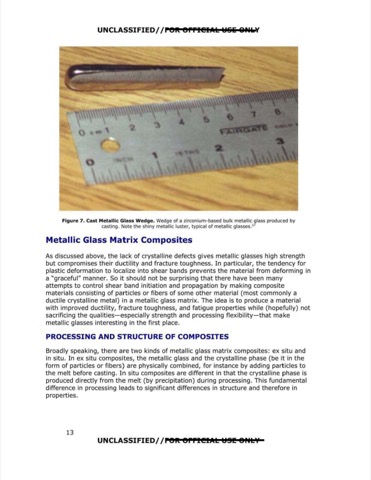
Image from page 19 of DOW-UAP-D117, as released by war.gov
Image from page 19 of the PDF. Open the scan to see the whole page.

Cite this page

U.S. Department of War. "AAWSAP DIRD, Metallic Glasses for Aerospace Applications, December 2009" (DOW-UAP-D117). PURSUE Release 06, U.S. Department of War, September 18, 2026. https://www.war.gov/medialink/ufo/sept-18/release-06/assets/DOW-UAP-D117_AAWSAP-DIRD-Metallic-Glasses-for-Aerospace-Applications-December-14-2009.pdf. Declassified UAP, page 19, https://declassifieduap.org/r/dow-uap-d117-aawsap-dird-metallic-glasses-for-aerospace-applications-december-2009/p/19. Accessed November 28, 2026.

This address shows page 19 on its own; /r/dow-uap-d117-aawsap-dird-metallic-glasses-for-aerospace-applications-december-2009?page=19 opens the same page in the full reader. Both stay. How to cite.