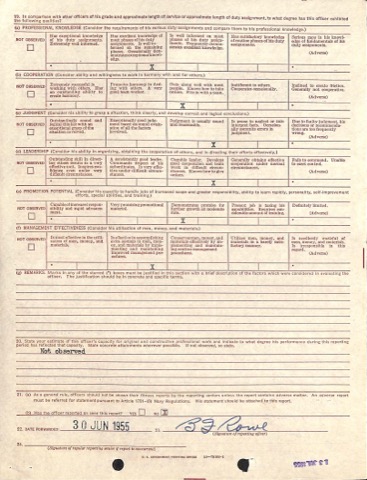
Text of page 532
19. In comparison with other officers of his grade and approximate length of service or approximate length of duty assignment, to what degree has this officer exhibited
the following qualitles?
(a) PROFESSIONAL KNOWLEDGE (Consider the requirements of his varlous duty assignments and compare them to his professional knowledge.)
Has exceptional knowledge
Of
Has excellent knowledge of
Is well informed on most
NOT OBSERVED
his duty
most phases of his duty
phases of his duty
Has satisfactory knowledge
assignments.
assign-
of routine phases of his duty
Extremely well informed.
assignments.
Is well in-
ments.
Frequently demon-
assignments.
formed
on
the
remaining
strates excellent knowledge.
phases.
Occasionally dem-
Serious gaps in his knowl-
edge of fundamentals of his
duty assignments.
(Adverse)
onstrates exceptional knowl-
edge.
X
COOPERATION (Consider ability and willingness to work in harmony with and for others.)
NOT OBSERVED
Extremely successful in
working with others.
Has
an outstanding ability to.
create harmony.
Promotes harmony in deal-
ing
with others.
good team worker.
A
very
Gets along well with most
people.
Knows how to take
orders. Fits in with a team.
Indifferent to others.
Cooperates occasionally.
X
(C)
JUDGMENT
(Consider his ability to grasp a situation, think clearly, and develop correct and logical conclusions.)
Outstandingly
sound
and
Exceptionally good judg-
Judgment is usually sound
NOT OBSERVED
logical thinker with an
ment based on sound evalu-
and reasonable.
exceptional grasp of the
ation of all the factors
situation involved.
in volved.
Is prone to neglect or mis-
interpret facts.
Occasion-
ally commits errors in
judgment.
(d) LEADERSHIP
(Consider his ability in organizing, obtaining the cooperation of others, and in directing their efforts effectively.)
Outstanding skill in direct-
A consistently good leader.
Capable leader. Develops
Generally obtains effective
NOT OBSERVED
ing others results in a very
Commands respect of
good cooperation and team
cooperation under normal
effective unit.
Inspires con-
subordinates.
Is very effec-
work in
diflicult circum-
event
circumstances.
fidence
very
tive under difticult circum-
stances.
Knows how to give
difficult circumstances.
stances.
orders.
Inclined
Generally not cooperative:
(Adverse)
Due to faulty judgment, his
decisions or recommenda-
tions are too frequently
wrong.
(Adverse)
Fails to command. Unable
to exert control.
(Adverso)
(e) PROMOTION POTENTIAL (Consider his capacity to handle jobs of Increased scope and greater responsibility, ability to learn rapidly, personality, self-improvement
efforts, special abilities, and training.)
NOT OBSERVED
Capable of increased respon-
sibility and rapid advance-
ment.
Very promising promotional
material.
Demonstrates
promise for
further growth at moderate
rate.
(f) MANAGEMENT EFFECTIVENESS
(Consider his utilization of men, money, and materials.)
NOT OBSERVED
Is most effective in the utili-
zation of men, money, and
materials.
Is effective in accomplishing
extra savings in men, mon-
ey, and materials by imple-
menting
and
maintaining
improved management pro-
cedures.
Conserves men, money, and
materials effectively by im-
plementing and maintain-
ing routine management
procedures.
Present
job
capabilities.
is
taxing his
Requires con-
siderable amount of training.
matiris men, monty sans
factory manner.
Definitely limited.
(Adverse)
Is needlessly
wasteful
of
men, money, and materinis.
Is
irresponsible
regard.
in
this
(Adverse)
(g) REMARKS.
Marks In any of the starred
boxes must be justified in this section with a brief description of the factors which were considered in evaluating the
officer.
The justification should be in concrete and specific terms.
20.
State your estimate of this officer's capacity for original and constructive
professional work and indicate to what degree his performance during this reporting
period has reflected that capacity.
State concrete attainments wherever possible.
If not observed, so state.
Not observed
21.
(a)
As a general rule, officers should not be shown their fitness reports by the reporting seniors unless the report contains adverse matter. An adverse report
must be referred for statement pursuant to Article 1701-(8) Navy Regulations.
His statement should be attached to this report.
(b) Has the officer reported on seen this report?
NO
22. DATE FORWARDED
30 JUN 1955
23.
24.
(Signature of regular reporting senior if report is concurrent)
37 Rowe
(Signature of reporting officer)
U. S. GOVERNMENT PRINTING OFFICE
16—70109-1
SS6: 70G & T