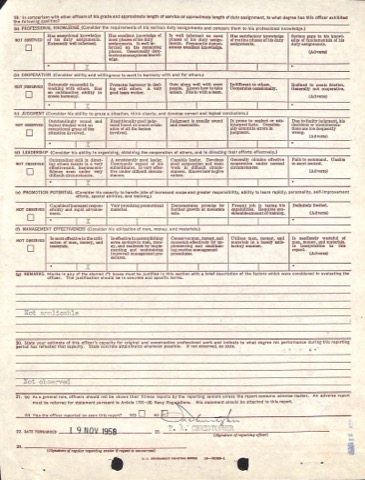
Text of page 509
the following quantish other officers of his grade and approximate longth of sorvice or approximate length of duty assignment, to what degree has this officer exhibited
(a) PROFESSIONAL KNOWLEDGE. (Consider the requirements of his varlous duty assignments and compare them to his professional knowledge.)
Has exceptional knowledge
Has excellent knowledge of
Is
well informed on most
Has satisfactory knowledge
Serious
gaps in his knowl-
NOT OBSERVED
his duty
assignments.
most phases of his duty
assignments.
phases of his duty
assign-
of routine phases of his duty
edge of fundamentals of his
Extremely well informed.
Is well in-
ments.
Frequently demon-
assignments.
duty assignments.
formned
on
the
remaining
phases.
strates excellent knowledge.
Occasionally dem-
(Adverso)
onstrates exceptional knowl-
edgo.
(b) COOPERATION (Consider ability and willingness to work In harmony with and for others.)
NOT OBSERVED
Extremely successful in
working
with others.
Has
an outstanding ability
create harmony.
to
ing
Pro wites others in deny-
with others.
very
good team worker.
Gets along well with most
people.
Knows how to take
orders.
Fits in with a team.
Indifferent to others
Cooperates occasionally.
Inclined
to create friction.
Generally not
cooperative.
(Adverse)
X
(c) JUDGMENT (Consider his abiifty to grasp a situation, think clearly, and develop correct and logical conclusions.)
Outstandingly sound
NOT OBSERVED
logical thinker with an
and
Exceptionally good judg-
Judgment is usually sound
ment based on sound evalu-
and reasonable.
exceptional grasp of the
ation of all the factors
situation involved.
involved.
Is prone to neglect or mis-
interpret facts.
Occasion-
ally commits errors in
judgment.
Due to faulty judgment, his
decisions or recommenda-
tions are too frequently
wrong.
(Adverse)
(d)
LEADERSHIP (Consider his ability In organizing, obtaining the cooperation of others, and in directing their efforts effectively.)
Outstanding skill in direct-
A consistently good leader.
Capable leader. Develops
Generally obtains effective
NOT OBSERVED
ing others results in a very
Commands respect of his
good cooperation and team
effective unit. Inspires con-
subordinates.
cooperation under normal
Is very effec-
work in
difficult circum-
fidence
even
circumstances.
under
very
tive under diflicult circum-
stances.
orders.
Knows how to give
diflicult circumstances.
stances.
Fails to command. Unablo
to exert control.
(Adverse)
(e) PROMOTION POTENTIAL (Consider his capacity to handle Jobs of Increased scope and greater responsibility, ability to learn rapidly, personality, self-Improvement
offorts, special abilities, and training.)
NOT OBSERVED
Capable of increased respon-
sibility and rapid advance-
ment.
Very promising promotional
material.
Demonstrates
promise for
further growth at moderate
rate.
Present job
capabilities.
is
taxing his
Requires con-
siderable amount of training.
Definitely limited.
(Adverso)
MANAGEMENT EFFECTIVENESS
(Consider his utilization of men, money, and materials.)
NOT OBSERVED
Is most effective in the utili-
zation of men, money, and
materials.
Is effective in accomplishing
extra savings in men,
mon-
ey, and materials by imple-
menting
and
maintaining
improved management pro-
cedures.
Conserves men, money, and
materials effectively by im-
plementing and maintain-
ing routine management
procedures.
Utilizes men, money,
and
materials in a barely satis-
factory manner.
Is needlessly
wasteful
of
men, money, and materials.
Is
irresponsible
regard.
in
this
(Adverso)
•
(g) REMARKS.
Marks in any of the starred (*) boxes must be justified in this section with a brief description of the factors which were considered In evaluating the
officer.
The justification should be in concrete and specific terms.
Not applicable
20.
State your estimate of this officer's capacity for original and constructive professional work and indicate to what degree his performance during this reporting
period has reflected that capacity.
State concrete attainments wherever possible.
If not observed, so state.
, 4
Not observed
21. (a) As a general rule, officers should not be shown their fitness reports by the reporting seniors unless the report contains adverse matter. An adverse report
must be referred for statement pursuant to Article 1701-(8) Navy Regulations.
His statement should be attached to this report.
(b)
Has the officer reported on seen this report?
22. DATE FORWARDED
1 9 NOV 1958
23.
hm
T. A. CHRISTOPHER
(Signature of reporting officer)
24.
(Signature of regular reporting senior if report is concurrent)
U. S. COVERNMENT PRINTING OPPICE
16-70109-1