Text of page 45
MARCH 19, 1948
339
0•3
Cop
0-2
RN
e -0-43x10%
THE AEROPLANE
M. B. Morgan has recently communicated the following
values for the limit of stability at the stall from this graph:—
Upper limit of the Angle of Sweep-back (referre‹
o the & chord) beyond which self-stall can be
expected
Aspect Ratio Required
Degrees
651
FLAT PLATE
T-O
0-05
0-01
T/C
0-4
0-5
0-6
THICKNESS RATIO
0-7
0-8
09
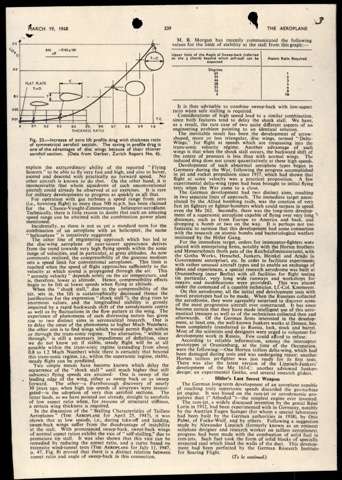
Fig. 23.—Increase of zero lift profile drag with thickness ratio
of symmetrical aerofoil section.
The saving in profile drag is
one of the advantages of disc wings because of their thinner
aerofoil section. (Data from Gerber, Zurich Report No. 6).
explain
Saucers
the extraordinary ability of the reported " Flying
" to be able to fly very fast and high, and also to hover,
ascend and descend with practically no forward speed.
other aircraft is known to do that.
On the other hand, it is
inconceivable that
whole
squadrons of such
unconventional
aircraft could already be observed at air exercises.
for military developments to progress as quickly as all that.
For operation with gas turbines a speed range from zero
(i.e., hovering flight) to more than 500 m.p.h. has been claimed
for
the
Chance-Vought-Zimmermann
helicopter-aeroplane.
Technically, there is little reason to doubt that such an amazing
speed range can be attained with the combination power plant
mentioned
Incidentally, as there is not as yet a standard term for the
combination of an aeroplane
with an helicopter,
" helicoplane
The other line of engineering approach which has led to
the disc-wing
of near-saucer appearance
from the trend towards very high flying speeds within the sonic
range of velocities, and in particular,
at great altitudes. As now
commonly realized, the compressibility of the gaseous medium
sets a speed limit for conventional aeroplanes.
reached when the speed of flight approaches sufficiently to the
velocity at which sound is propagated through the air.
" acoustic velocity" depends solely on the air temperature.
is, therefore. lower at altitude.
compressibility effects
begin to be felt at lower speeds when flying at altitude
* shock stall,
due to the compressibility of the
air, sets in,
the lift is catastrophically decreased (hence the
justification for the expression
" shock stall "), the drag rises to
enormous
longitudinal stability is grossly
impaired by a rapid backwards shift of the aerodynamic centre
as well as by fluctuations in the flow pattern at the wing.
experience of phenomena of such distressing nature has given
to two distinct aims in aeronautical
rose la te dist of the phenomena to higher Mach Numbers;
the other aim is to find wings which would permit flight within
or through the trans-sonic regime.
The alternative.
through.'
is still a necessary
impediment of definition, since
we do not know yet if stable, steady
possible within the trans-sonic regime (extending from about
0.8 to 1.2 Mach Number) while there is certainly that beyond
this trans-sonic regime, i.e., within the supersonic regime, stable,
steady fight can be predicted.
Two simple
means have become known which delay the
occurrence of the " shock stall"
until much higher (but still
leading
either as sweep back or as sweep
forward.
Farnborough
discovery of nearly
30 years ago, when high top speeds of airscrews were investi-
gated-is the adoption of
very thin aerofoil sections.
latter leads. as we have pointed out already, straight to aerofoils
of low aspect
ratio when. for reasons of structural stiffness.
a certain wing thickness is required.
In the discussion of the " Stalling Characteristics of Tailless
Aeroplanes
shown
AEROPLANE for April 25.
that at low speeds.
during take-off and landing.
swept-back wings suffer from the disadvantage of instability
at the stall.
With pronounced sweep-back, swept-back wings
of normal aspect ratios exhibit the vice of " self-stalling." due to
premature tip stall.
It was also shown that this vice can be
remedied by reducing the aspect ratio, and a curve based on
extensive wind-tunnel tests (THE AEROPLANE for July 11. 1947.
p. 47, Fig.
8) proved that there is a
aspect ratio and angle of sweep-back in this connection.
It is thus advisable to.
sweep-back with low-aspect
ratio when safe stalling is required.
Considerations of high speed lead to a similar combination,
since both features tend to
as a result, the rare case of two quite different aspects of an
engineering problem pointing to an identical solution
been the development of
; more or less triangular.
disc wings, termed " Delta-
are trespassing into the
wings is that when the shock stall occurs, the backward shift of
the centre of pressure is less than with
induced drag does not count quantitatively at these high speeds.
Development of such abnormal aeroplane types began in
Germany during the War, following the progress accomplished
in jet and rocket propulsion since 1937, which had shown that
was a practical proposition.
experimental delta-wing types had been brought to initial flying
tests when the War came to a close.
The German development had two distinct aims, resulting
in two separate lines of approach.
The immediate target neces-
sitated by the Allied bombing raids,
was the creation of very
fast jet fighters or fighter-bombers which could surpass in speed
even the Me 262.
Secondly, there was the long-term develop-
ment of a supersonic aeroplane capable of flying over very long
such as from Europe to America
and back, and
dropping a bomb or two on the way.
It is perhaps not too
fantastic to surmise that this development had some connection
with the research on atomic bombs and bacteriological warfare
instituted by the Hitler Gang.
placed with enterprising
laced which enterprising gers, nora bly with the orien brothers
and Messerschmitt (both pets of the Reichsluftministerium), with
the Gotha Works, Henschel,
Junkers, Heinkel and Arado (a
Government enterprise), etc. In order to facilitate experiments
with rather unusual aircraft types and to enable an exchange of
ideas and experiences, a special research aerodrome was built at
Oranienburg (near Berlin) with all facilities for flight testing
(in particular, very long wide runways and
repairs and modifications were provided).
under the command of a capable technician, Lf.-Col. Knemeyer.
On this aerodrome, all the initial and development tests with
novel prototypes had to be made.
When the Russians collected
the aerodrome, they were agreeably surprised to discover some
of the most progressive aircraft ever constructed. It has since
become certain that they have made intelligent use of this aero-
nautical treasure as well as of the technicians collected then and
interested in the develop-
ment, at least one, the well-known Junkers works at Dessau, has
been completely transferred to Russia, lock, stock and barrel.
Most of the scientists and designers were urged to volunteer for
development work in Russia.
Few could afford to refuse.
among the interceptor
were the following:-One
at Oranienbur orten tailless delta-wing, which had
been damaged during tests and was undergoing repair; another
Horten tailless jet-fighter was just ready for its first tests.
There was also the latest version of the Lippisch-Junkers
development of the Me 163-C:
design; an experimental Gotha, and several research gliders.
Hitler's Last Secret Weapon
The German long-term development of an aeroplane capable
of reaching truly supersonic speeds discarded the
It was based on the ram-jet or aerodynamic pro-
pulsive duct (* Athodyd")-the simplest engine ever invented.
The ram-jet, a widely discussed invention by the genial Réné
Lorin in 1912, had been experimented with in Germany, notably
by the Austrian Eugen Saenger (for whom a special laboratory
built by the German authorities in 1938), by Otto
abst. of Focke-Wulf
nade by Alexander Lippisch (formerly known as an eminent
sailplane designer and research worker on tailless aeroplanes).
progress had been made with the combustion of solid fuel in
Such fuel took the form of solid blocks of specially
prepared coal which lined the walls of the duct.
ment had been
perfected by the German Research Institute