DOW-UAP-D093

Analysis of Flying Object Incidents in the United States, 1948, page 39

One page of a U.S. government record released under PURSUE, shown on its own with its text. The record page has the whole document, its catalog details and the scan.

Page
39 of 67
Agency
Department of War
Released
Release 04, July 10, 2026

Archive note war.gov gives the location as Virginia. The study analyses incidents across the United States, so this archive does not place it on the map. See all corrections

Text of page 39

8. On 1 July 1947, a GdA radar at lokkuido, Japan picked up an unidentified target at 16 miles, with a speed in excess of 500 mph. This taxget split Into two targots, onch estimated to be larger than a P-bl. D. On 16 Septenber 1947, en KAV radar at Pulcuolta, Japan, picked up a targot at 89 miles and trailed it to 19 miles, where it faded. Speed was 840-900 mph. The spoed measurement, made by a 600d crew through a 70-aile track, is belloved accurate. 4. Investigations conducted by Headquarters, Mir linteriel Con- mand, have definitely established the identification of 18 of approxi- nately 210 so-called flying snucers which havo been reported. Approxi- nately nine per cent of the total nunber of incidents are, therefore, eliminated from further specific consideration. Among those incidents positively explained, three were hoaxes, two vero from unrelieble wit- nesses. In the romaining 13 eliminated incidents, objecte vere actually soon but investigation hns shown that they were celestial bodies or phenomena, meteorological and carnival balloons, and airborne cosmic ray exporimental equipment. The following examples are presentod for cou- parison of the information reported by witnesses and true identification of the object involved: B. On 22 July 1918, Captain Henry Glover (Ordnance Reserve) and his wife observed at Van Wuys, California, an objeet which they were unble to positively identify. Object at fizet appeared to be round and looked like a weather blloon at about 2,000 feet but there was no characteristic bobbing. The wind was blowing on the ground bat the object wan quite stoady. During the time it was under observation, about an hour, it traveled through a vertienl are of about twenty-five (25°) degrees or more. The observer concluded that it was not a celestial body. It hnd, a bluish luninescence and as the sun set, the object's color gradually changed to ornnge at dusk and ceased to be illuminated

Machine-read (OCR) from the scan by this archive; it can contain errors. The scan is the record.
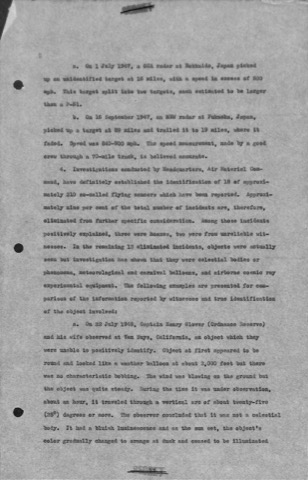
Image from page 39 of DOW-UAP-D093, as released by war.gov
Image from page 39 of the PDF. Open the scan to see the whole page.

Cite this page

U.S. Department of War. "Analysis of Flying Object Incidents in the United States, 1948" (DOW-UAP-D093). PURSUE Release 04, U.S. Department of War, July 10, 2026. https://www.war.gov/medialink/ufo/071026/release_04/documents/DOW-UAP-D093_Analysis-of-Flying-Object-Incidents-in-the-US_1948.pdf. Declassified UAP, page 39, https://declassifieduap.org/r/dow-uap-d093-analysis-of-flying-object-incidents-in-the-united-states-1948/p/39. Accessed November 28, 2026.

This address shows page 39 on its own; /r/dow-uap-d093-analysis-of-flying-object-incidents-in-the-united-states-1948?page=39 opens the same page in the full reader. Both stay. How to cite.