Text of page 91
doet
L01
4
-coples,
Series
age
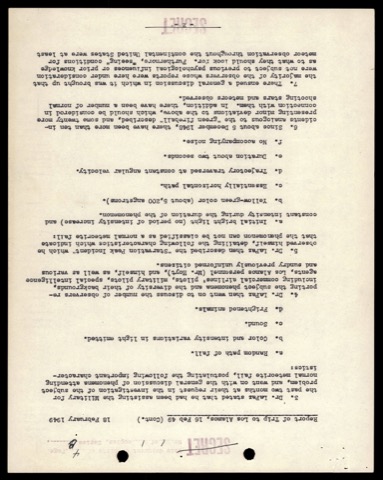
Report of Trip to Los Alamos, 16 Feb 49 (Cont.)
18 February 1949
Dr. LaPaz stated that he had been assisting the Military for
the past two months at their request in the investigation of the subject
problem, and went on with the general discussion of phenomena attending
normal meteorite fall, postulating the following important character-
istics:
8. Random path of fall.
bo Color and intensity variations in light emitted.
c. Sound.
d. Frightened animals.
4. Dr. LaPaz then went on to discuss the number of observers re-
porting the subject phenomena
and the diversity of their backgrounds,
including commercial airlines' pilots, military pilots, special intelligence
agents, Los Alamos personnel (Mr. Hoyt), and himself, as well as various
and sundry previously uninformed citizens.
5. Dr. LaPaz then described the "Starvation Peak Incident" which he
observed himself, detailing the following characteristics which indicate
that the phenomenon can not be classified as a normal meteorite fall:
a.
Initial bright light (no period of intensity increase) and
constant intensity during the duration of the phenomenon.
bo Yellow-green color (about 5,200 angstroms).
c. Essentially horizontal path.
d. Trajectory traversed at constant angular velocity.
e. Duration about two seconds.
f. No accompanying noise.
6. Since about 5 December 1948, there have been more than ten in~
cidents analogous to the "green fireball" described, and some twenty more
presenting minor deviations to the above, which should be considerod in
connection with them.
In addition, there have been a number of normal
shooting stars and meteors observed.
There ensued a general discussion in which it wes brought up that
the majority of the observers whose reports were here under consideration
were not subject to previous psychological influences or prior knowledge
as to what they should look for. Furthernore, "seeing" conditions for
meteor observation throughout the continental United States were at least
2
NW 91526