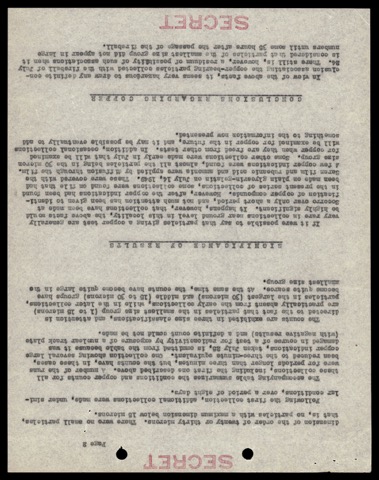
Text of page 6
SECRE
Page 2
dimension of the order of twenty or thirty mierons. There were no small partioles,
that 1s, no partieles with a maximum dimension below 15 microns. .
Following the first collection, additional collections were made, under sini-
lar conditions, over a period of eight days.
The accompanying table summarises the conditions and copper counts for all
these collections, ineluding the first one described above. A number of the runs
were for periods longer than three minutes, but the counts have, in these cases,
been reduced to the three minute equivalent. one collection showing several large
copper indications, taken July 25, is omitted from the table because it was
damaged in course of a test for radioativity by exposure of a nuclear track plate
(with negative resulto) and a definite count cold not be made.
The counts are exhibited in three size classifications, and attention is
directed to the fact that particles in the smellest size group (1 to 15 microns)
are practically absent from the early collections, while in the later collections,
particles in the largest (30 microns) and middle (15 to 30 microns) groups have
becone quite scarce.
At the same tine, the counts have becone quite large in the
siallest size group.
SIGNITICANCE OF RESULTS
If it were possible to say that particles giving a copper test are generally
very rare in collections near ground level in this locality, the above facts to uld
bo highly significant. It happens, however, that collections have been made at
Socorro over only a short period, and not much attention has been given to identi-
fication of copper compounds. However, after the copper indications had been found
in the prosent series of collections, some collections were found on file that had
been made on plain glyeerin-selatin on July 14, 1949. These were covered with the
Saran film and rubeanie asid and armonia were applied by diffusion through the tilm.
A few copper indications were found, almost all the particles being in the 30 mieron
size group. Some other collections were made early in July that will be examined
for copper when they are freed from other tests. In addition, occasional collections
will be examined for copper in the future, and it may be possible eventually to add
something to the information now presented.
CONCLUSIONS REGARDING COPPER
In view of the above facts, it seems very hazardous to drew any definite con-
clusion associating the copper-bearing partioles collected with the fireball of July
There still is, however, a residum of possiblity of such associations men 1t
is considered thet particles of the smallest size group did not appear in large
numbers until some 35 hours alter the passage of the fireball.
SECRET
NND 58378