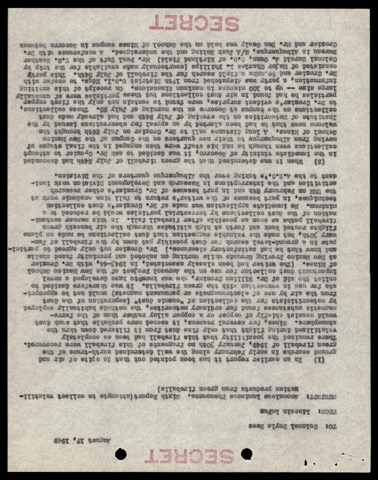
Text of page 10
• SECRET
Anguat 17, 1949
TO: Colonel Doyle Rees
FROM: Lincoln LaPan
SUBTIOT: Anomalous Luminous Phenonena. Sixth Report (attempts to colleet volatill-
zation products from green fireballs)
In an earlier report it has been pointed out that in spite of air and
ground searche in early February along the well deterined earth-trace of the
green fireball of 1949, January 30th no fragments of this fireball were recovered.
There remained the possibility that this fireball had been so completely
volatilized during flight that only fine dust from it filtered down thru the
atmosphere. Since, foz several reasons, it seemed more probable that such dust
would consist chiefly of copper or a copper alloy rather than of the ferro-
magnetie substances found for ordinary neteorites, the methods habitually employed
by meteoriticists for the collection of "coania dust" (separation of the dust
from the air by use of electromagnets or permanent magnets) voulá not be appropri-
ate for use in connection with the green fireballs. It was therefore deeided to
enlist the aid of Dr. W121iam Crozier, who wes knownto have developed a novel
impaotnent dust collector for use on the Aerosol Project of the New Mexico School
of Mines. (The writer had been closely associated, in 1943-44, with Dr. Crozier
at New Mexico Proving Grounds while working on saboted and proximity fused shells
and knew that he had satisfactory clemrance.) Dr. Crozier not only agreed to partici-
pate in a ground-level search for dust possibly put down by the fireball of Jan-
uary ,30th, but made the valuable suggestion that dust collections be made on plene
flights routed back and forth at high altitudes through the air beneath green
fireball paths as soon as possible after fireball fall. In this manner contani-
nation of the dust collections by terrestrial particles would be reduced to a
minimui. No immediate application was made of Dr. Grozier's dust colleetion
techniques, in part because of the writer's return to full time ncadenie work at
the UNM on Februry 8th and in part because of Dr. Crozier's other zesearch
activities and the interruptions in Research and Development Division work inci-
dent to the A.5.C.'s taking over the Albuquerque quarters of the Division.
When it was determined that the green tireball of July 24th had descended
in the immediate violnity of Socorro, it wes decided to ask Dr. Crozier to attempt
collections even though he and his staff were then engaged in the final stages of
moving from Albuquerque to their new quarters on the Campus of the New Mexico
School of Minos. A long distance call to De, Grozier on July 86th brought the
welcome news that he had been alerted by an appeal for observations issued by the
Institute of Meteorities on the evening of July 84th and had already made dust
collections on the campus at Socorro on the morning of July 25, These collections,
to Dr. Crozier's evident surprise, were found to contain not only the firet copper
particles he had found.in air dust collections but these particles were of unusually
large size - up to 100 microns in maximun dimensions. On receipt of this exciting
information, a party was dispatched from 17th Distriet 0.S.I. Hags. to confer with
Dr. Crozier and to make a field search for the fireball of July 24th, This party
consisted of Major Charles I, Phillips (courteously made available for the trip by
Colonel Harold A Gunn, C.0, of Kirtland Pield) Mr. Paul Taft of the U.S, Weather
Bureau in Albuquerque, S/A Jack Boling and the undersigned. A conference with Dr.
Grozier and Mr. Ben Seely was held on the School of Mines campus in Socorro between
SECRET
NND 58378