CIA-UAP-012
Combating Fatigue In Crewmembers
- Agency
- CIA
- Format
- Document, 2 pages
- Incident date
- November, 1976
- Place
- Not given
- Released
- Release 03, June 12, 2026
- Source
- war.gov
- Topics (archive tags)
- Military aircrew
Description from war.gov
Page 1
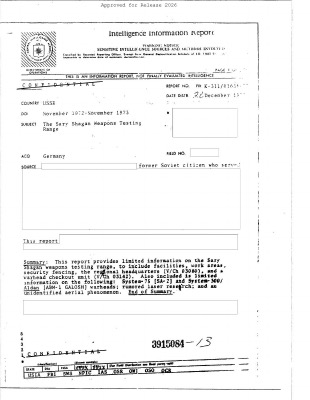
Approved for Release 3026- GONELO Domestic Collection Division Foreign Intelligence Iaformation Report DIRECTORATE OF OPERATIONS COUNTRY USSR DCD REPORT NO. SUBJECT Combating Facigue in Crewmembers/ DATE DISTR. Aeroflot Work Cycles/Use of Drugs/ Biological Effects of Aircraft Noise/ NO. PAGES Radiation Research/UFO Phenomena/ Prototype Pilot Biological Psychomotor REFERENCES Testing Equipment/Celestial Navigation/ Noht Vision Testing DATE OF INFO THIS IS UNEVAIUATEO INFORMATION 00- 8-321/33474-76 10 November 1976 4 SOURCE COPY SUMMARY: Aeroflot officials are actively involved in aerospace medical research. They are concerned with the medical aspects of physical conditioning which impinge upon crewnember perform- ance and have perfected several devices which test pilot bio- logical functioning and motor response ability. Dr Inal Georglyevich Akoyev, a noted radiation biologist explained cosmic ray parcicles (phosphenes) which are causing Aeroflot pilots to "see" flashes of light during night flying. Dr (Enu] Akucin, coberneticist at the Civil Aviation Institute of Leningrad showed prototype pilot biological psychomotor testing equip- ment which measures blood pressure, pulse rate, cardiovascular function and motor ability. The equipment is automatic and test- ing is completed in approximately three minutes. 5 1. The Soviets deal with crewmember fatigue in several ways. First, they emphasize and promote physical conditioning. • If a crewmember is physically fit, he will be less prone to fatigue and will recover sooner after tiring flights. Aeroflot provides exercise facilities at all major alr.- ports, and these facilities are supervised by a well known athlete. The second thing they do is to thoroughly test each cremember prior to flight to insure his physical fitness and mental alertness. At the present time, these tests are conducted by a medical team headed by a doctor, usualiy a woman. A cremember is not allowed to fly if he fails the examination.:' These tests are now being automated and will take only 1-3 minutes when the recent it goe prototype equipment becomes operational. Finally, there is a third approach Aeroflot is using--a prophylactorium. Each major airport has one, a 3 to 4 story building set off from che main airport buildings, but easily acces- sible by foot. These Facilities are well landscaped and are designed to provide total rest and relaxation for transient crewnembers. They have a large kitchenPage 2
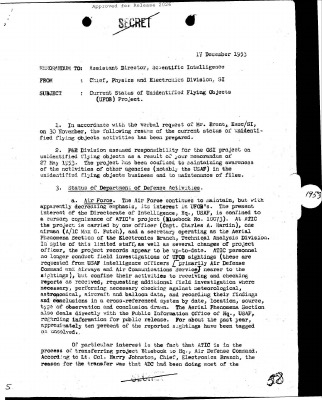
00B-321/3J474-76 3 Dr Akeyey asked for personal opinion of the UFO phernmener:. He was told that 99 percent of these occurrentus were traceable to either nacaral or man-made phenomena such as celestial movenent, air- crait or artificial satallites, and that the other one percent cannot be expiained--possibly an hallucination. Akoyev chen asked, "Do you think it is possible...could there be some:hing coming from outer space?" 7. Dr linul Akutin, a cybernecicist at the Civil Aviation Institute of Leningrad. has developed several prototypes of pilot testing equipment. The equi:ent is planned to replace post of the current duties of medical personnel who examine pilots prior to flight. The automatic devices will be installed in ali airport flight operations facilicies. Akucin and his tenonstrated a set of instruments which automat- teally moreore a pilot's blood pressure and pulse rare, vascula: functioning with a electro cardiogzam, and test hi: motor reaction 8. The device is activated by inserting a small metallic plate into the testing machine. The plate, one of which is carried by each crewmember, contains a biological baseline on that particular individual. His normal blood pressure, pulse rate, electrocardiogram, and motor ability are coded into the metal This plate is updated annually, or more often if required. After rhe plate is inserted into the machine, the pilot places the middle finger of each hand into two little holes and rests his wrists on two small metal plates on a table. Small, automatic pneumatic cups close around the fingers and inflate. The machine then measures the blood pressure and pulse rate by comparing the two fingers, computing a mean, and then comparing the result with the encoded information on the pilot's plate. The systolic and diastolic blood pressure and pulse race are chen displa)en on the face of the machine in an electronic digital form. At the same the machine automatically administers an electrocardiogram "across the heart" and displays this on a cathode-ray tube. If auy of these values .. outside the normal scandad for that particular individual, a light illun.• rates and further examination is required by a medical doctor. If no lighL 11luminates, the pilot is passed. 9. The pilot then faces a panel of red and green colored lights. On the panci are green and red colored buttons. The lights begin to illuminate in a randon fashion, with the pilot being required to press the corresponding color button immediately to extinguish the colored light. This test continues for approximately 20-30 seconds, during which the lights flash in a random sequence. At the end of the testing period, the machine scores the pilot's performance and digitally displays his score in che number of correct and wrong responses. If he scores as high or higher than his standard, he is passed; if his score is lower, a light illuminates and furcher examination is required by a medical doctor. separate programs which are randomly selected, making it impossible to memorize the sequence of the lights. 10. Finally, the pilot is seated before a miniature cockpit with a control stick and an attitude indicator.. The control stick must be moved to keep the attitude indicator (artificial horizon) straight and level. The indicator pitches up and down and from side to side and very closely dupii- cates actual instrument flying conditions. The control stick also closely approximated necessary pilot skills.. At the end of this test, che score is again displayed and, depending upon his standard, a pilot passes The entire sequence of testing, from taking blood pressure to the control stick evaluation, takes approximately three minuces. pilot passes all phases, his personal profile plate along with a certiii- cate card is returned to him. He must present the cercificate card to the flight dispatcher before he is allowed to board the aircraft. COPY 2 4 2The text is machine-read (OCR) from the scan and can contain errors. The scan is the record.
Cite this page
Central Intelligence Agency. "Combating Fatigue In Crewmembers" (CIA-UAP-012). PURSUE Release 03, U.S. Department of War, June 12, 2026. https://www.war.gov/medialink/ufo/061226/release_03/documents/CIA-UAP-012-Combatting_Fatigue_in_Crewmembers.pdf. Declassified UAP, page 1, https://declassifieduap.org/r/cia-uap-012combating-fatigueincrewmembers?page=1. Accessed November 28, 2026.
To cite one page, add ?page= and the page number to the record's address (?page=2 for page 2), or use the page's own address, /p/2 after the record's (select a "Page" heading in the text). How to cite.
Machine summary
Written by Claude Sonnet 5.5 (Anthropic) on November 25, 2026, from the full text of the record and war.gov's description. Checked against the record's full text on November 25, 2026. It is not part of the record and can contain errors; check it against the document.
This is a CIA Domestic Collection Division Foreign Intelligence Information Report, dated 10 November 1976, on Soviet Aeroflot and aerospace medical research. It says the Soviets address crewmember fatigue through physical conditioning, testing of each crewmember before flight, and a prophylactorium at each major airport. It describes prototype automatic equipment developed by a cybernetics specialist at the Civil Aviation Institute of Leningrad, which measures blood pressure, pulse rate, electrocardiogram and motor reaction, with the entire sequence taking approximately three minutes. The report also records that a radiation biologist asked for a personal opinion of UFO phenomena and was told that 99 percent of occurrences were traceable to natural or man-made phenomena and that the other one percent cannot be explained.
Most frequent words
Select one to highlight it in the text above.
Related records
Similar records 3
Closest matches by text: titles, war.gov descriptions and document text.